Skip to content
 EN
EN  DE
DE  العربية



Critical Control Point (CCP): Definition, Examples, and How It Differs from a CP and OPRP
A critical control point (CCP) marks the step where a control stops a food safety hazard from reaching the consumer, and where losing control makes the product unsafe. Two neighbors sit close to it: the control point (CP) and the operational prerequisite program (OPRP).
What is the difference between a critical control point and a control point?
Control is not the same as critical control. A control point is any step where a hazard can be managed: prewashing, sorting, a storage temperature that holds quality steady. Miss one and you get a quality problem or a slower line.
A critical control point is the step where control is necessary to prevent, eliminate or reduce a hazard to an acceptable level, and where a miss lets unsafe product out the door.
The operational prerequisite program sits between the two. It comes from ISO 22000 rather than Codex, and it covers measures that matter for safety but carry no limit you can monitor in real time. Sanitation. Supplier approval. A deviation at an OPRP triggers an assessment; a deviation at a CCP triggers a product hold. Auditors push on exactly that difference, and the whole HACCP system hangs on getting it right.
How do you identify a critical control point?
Identification starts in the hazard analysis, not in the decision tree. Work every step where a significant hazard turned up:
- Confirm the hazard is significant. Likely enough to happen and serious enough to hurt someone. Fails that test? You have a control point.
- A measurable limit has to exist. Temperature, time, pH, water activity, detector sensitivity. No number, no CCP.
- Monitoring speed decides more than people expect. A breach has to surface while you can still identify and hold the batch it affected. Slow feedback usually points to an OPRP.
- Look downstream. If a later step brings the hazard back to an acceptable level, that later step is your CCP.
- Write down the reasoning. An auditor will ask why cooling counts and chilled storage does not. Answer it once, on paper, and you never argue it twice.
The familiar four-question decision tree deserves a note. Codex dropped it when it revised the General Principles of Food Hygiene (CXC 1-1969) in 2020, and a new tree plus worksheet were adopted in December 2022. It was never obligatory in either version. Your reasoning has to hold up; the shape of the diagram does not matter.
What are examples of critical control points?
Cooking to a validated core temperature. Chilling within a set time. Metal detection before packing. Pasteurization and hot holding round out most plans, because the hazard and the limit are both easy to pin down.
Copying someone else’s list is where plans fall apart. Two bakeries running the same recipe can land on different CCPs, because the equipment and the ingredient specs differ. Quality control in food and beverage plants follows the same logic: the check has to match the line it runs on.
What is the most common failure point with CCPs?
Records that prove nothing. A monitoring sheet full of ticks tells an auditor the operator was there, not that the product was safe. Write the actual reading. The second failure follows straight after: someone notes a deviation, the line keeps running, and nobody records what happened to the affected product. Every breach needs a disposition and a corrective action with a name against it.
CCP vs OPRP vs PRP
Use this to place any control measure someone hands you before you sign the plan off.
| Aspect | CCP | OPRP | PRP |
|---|---|---|---|
| What it controls | A significant hazard at one defined process step | A significant hazard that resists sharp measurement | The hygiene baseline across the whole site |
| Basis | Codex Principle 2, ISO 22000 clause 8.5.4 | ISO 22000 clause 8.5.4, absent from classic HACCP | ISO 22000 clause 8.2, sector detail in ISO/TS 22002-1 |
| Criterion | A measurable critical limit | An action criterion, often observable rather than measurable | A fixed standard with no link to a specific batch |
| Monitoring | Continuous or per batch, always recorded | Planned, typically once per shift | To schedule, such as cleaning and pest monitoring |
| Response to a deviation | Hold the product, correct, release only on record | Correct and assess the product; hold only if needed | Adjust the program, no direct product decision |
| Evidence | A monitoring log per CCP carrying actual readings | Proof the measure was checked and worked | Cleaning schedules, training records, maintenance dockets |
| Example | Heating to core temperature, metal detection before dispatch | Metal detector function check at the start of the shift | Segregated storage for allergens |
Quick test: if releasing the batch hangs on a measured value, it is a CCP. If it does not, it is not.
Free CCP Determination Worksheet and Monitoring Log
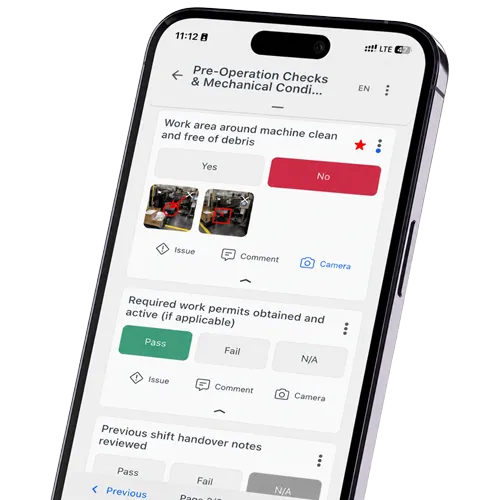
It walks each flagged step through the CCP test, then gives you the monitoring lines and the deviation log to record what was actually measured and what happened to the product when a limit broke. Download the checklist (PDF). Prefer it digital? Run this on phone, tablet or PC in flowdit.
Related Terms
- Compliance Audit is where your CCP records get tested by someone from outside.
- Quality Control checks the product; CCP monitoring checks the process that made it.
- Process Safety applies the same control logic to plants running hazardous processes.
- Root Cause Analysis is what a repeat deviation at the same CCP should trigger.
Further Reading
- HACCP Explained: Ensuring Food Safety from Farm to Table covers the wider system CCPs sit inside.