 Skip to content
 EN
EN  DE
DE  العربية



-
IoT Development for Smart Factories
IoT solutions built to power smarter manufacturing
No card required
Go live within a few hours





Chosen by the Teams That Keep Operations Running








Why choose custom IoT product development?
Off-the-shelf IoT solutions often lack the flexibility to meet the complex and unique requirements of your operations. Our custom development services help you:
- Design and build IoT devices tailored specifically for your use case
- Modify software and tools to align with your processes effortlessly
- Integrate IoT data with critical business tools like SAP, Odoo, and Zoho
- Scale your IoT ecosystem as your business grows
Why Partnering with flowdit Gives You a Competitive Edge
Increased operational efficiency: Custom IoT solutions automate manual tasks and provide real-time data, helping you streamline workflows and reduce downtime.
Enhanced data accuracy and insights Tailored products capture exactly the data you need, offering precise analytics that empower more informed decisions.
Competitive advantage through innovation: With unique IoT devices and software designed just for you, stay ahead of industry trends and outperform competitors.
Improved safety and compliance: Monitor environmental and operational conditions in real-time, reducing risks and meeting regulatory requirements easily.
Cost savings: Avoid unnecessary features and software bloat - get solutions that fulfill your company's demands.

Our technology expertise
We leverage IoT technologies and industry best practices to develop reliable and scalable IoT solutions
- Backend development with Laravel, ensuring robust APIs and business logic
- Mobile app development with Flutter for seamless cross-platform user experiences
- Embedded hardware platforms and sensor technologies
- Cloud providers like AWS, Azure, or Google Cloud for data storage and analytics
- Software development using languages such as Python, JavaScript, and C++
- API-first approach for seamless integration with your business systems
- IoT protocols including MQTT, CoAP, and HTTP for secure communication
Example use cases
Manufacturing downtime reduction
Custom vibration and temperature sensors monitor equipment health and trigger maintenance only as needed.
Logistics fleet optimization
GPS-enabled IoT devices track vehicle location and condition in real time, improving route planning and asset utilization.
Food & beverage safety monitoring
Humidity and gas sensors ensure storage environments meet safety standards, with alerts sent instantly if thresholds are breached.

Industries we serve
We’ve partnered with leading companies to deliver custom IoT products for
- Manufacturing & Industrial Automation
- Energy & Utilities
- Logistics & Supply Chain
- Food & Beverage
- Smart Buildings & Facilities
No matter your industry, our solutions adapt to your specific needs.
Chosen by the Teams That Keep Operations Running
How it works
- 1. Discovery: Understand your unique challenges and goals.
- 2. Design: Create a prototype of customized IoT hardware and software
- 3. Develop: Build and rigorously test your custom solution
- 4. Deploy: Implement with training and support.
- 5. Grow: Continuously optimize and scale your IoT system.
Ready to start your custom IoT product development journey?
Partner with flowdit to create IoT solutions that work perfectly for your business.
No card required
Go live within a few hours
Got questions?
Frequently Asked Questions
What is custom IoT product development?
The process of creating IoT devices and related software that are especially suited to your company's requirements in order to ensure smooth integration and peak performance is known as custom IoT product development.
Which industries do you serve?
We provide customized IoT solutions to address specific operational challenges across various industries, with experience in manufacturing, energy, logistics, smart buildings, and more
Can flowdit customize existing IoT platforms?
Yes, we offer a solution that is genuinely tailored for your environment by customizing and improving current Internet of Things (IoT) platforms to precisely match your operational needs.
How long does custom IoT product development take?
The development timeline for the IoT project depends on its complexity and scope. To ensure an efficient and transparent development process, we work closely with you to establish clear milestones and realistic deadlines.
How scalable are your custom IoT solutions?
Our solutions are designed with scalability in mind. Our IoT systems grow with your business, whether you are adding new features, expanding across multiple locations, or increasing the number of devices in your network. This ensures seamless integration, reliable connectivity, and less disruption as your business expands.
Do you integrate with business software like SAP or Odoo?
Absolutely. With flowdit, you can easily connect devices, and your IoT data will flow naturally into your current operations thanks to seamless integration with business systems like SAP, Odoo, Zoho, and many more.
How do you ensure interoperability between an IoT product and existing industrial systems (MES/ERP/CMMS)?
Ensuring interoperability requires designing IoT products within an open, standards-based IoT infrastructure and framework that uses protocols such as OPC-UA, MQTT, or RESTful APIs. These interfaces enable IoT devices to seamlessly communicate with existing systems like MES, ERP, and CMMS. Additionally, data transformation layers or middleware may be necessary to translate between different data formats and legacy systems, ensuring smooth integration.
What role does edge computing or on-device intelligence play in IoT product development?
Since they reduce latency and enable real-time decision-making, edge computing and on-device intelligence are essential to the development of contemporary IoT products. The solutions improve speed and reliability while reducing dependency on cloud services by processing data locally. By ensuring sensitive information stays on the device, they also support data privacy. For industrial IoT applications that are time-sensitive or mission-critical, this is very beneficial.
How do you plan device lifecycle management, updates, and security throughout the industrial IoT development process?
In industrial IoT, rigorous security protocols, frequent software updates, and ongoing monitoring are all necessary for effective device lifecycle management. Updates ought to be planned to reduce downtime and guarantee that critical infrastructure remains functional. Every step of the process, from production to decommissioning, requires the integration of security features including encryption, authentication, and firmware validation. Additionally, device management software should enable seamless updates across the device fleet.
What are best practices for prototyping, testing, and preparing an IoT device for production ?
Iterative prototyping with ongoing input from actual use cases is one of the best approaches.Testing should cover functionality, security, and scalability, with special attention to regulatory compliance (e.g., CE, UL certifications). Quality assurance should involve rigorous validation against specifications, and audit requirements must be met with detailed logs for traceability. Finally, the device should be stress-tested under various environmental conditions to ensure durability.
What kind of ongoing support do you offer?
We provide comprehensive support, which includes maintenance, updates, and ongoing improvements, to make sure that your IoT system develops with your requirements.
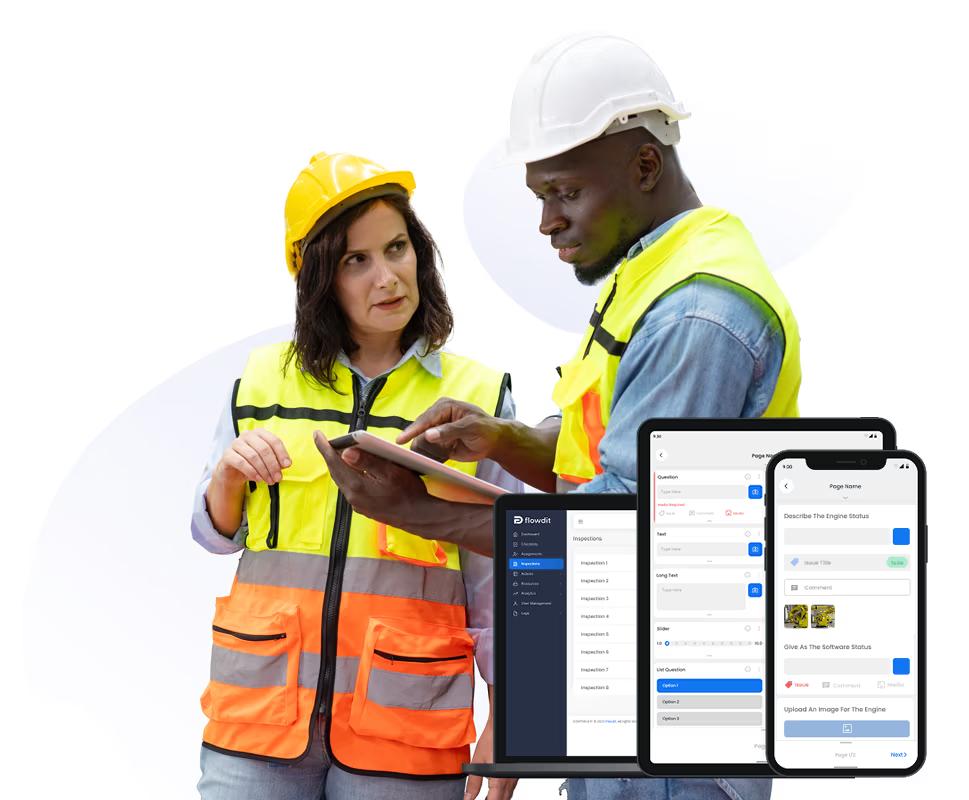
How do you integrate checklists, digital audits, and connected-worker workflows into IoT-driven asset monitoring or condition-based maintenance?
Integration involves embedding digital checklists and audit features directly into IoT platforms. These systems can initiate automated processes for condition-based maintenance by utilizing data collected from IoT devices and analytics, ensuring that issues are identified and resolved proactively. Connected worker solutions can offer real-time access to necessary tasks, reports, and alerts via mobile apps, ensuring that operators and maintenance personnel are informed and aligned at all times.