Skip to content
 EN
EN  DE
DE  العربية



Andon: Definition,Light Colors and Jidoka Difference
Andon signals a problem the moment it happens: a light, a button or a board that calls for help at the station. It belongs to jidoka, the Toyota pillar it usually gets mistaken for. Jidoka is the principle. Andon is what makes it visible on the floor.
What are the parts of an andon-system?
Five pieces. The last two are the ones plants skip.
- Trigger. A cord, a button, a tablet, or a sensor that trips on its own. Whoever spots the problem raises it without walking away from the job.
- Signal. The lamp or stack light at the station, showing how bad it is.
- Board. One screen for the whole line, so a supervisor sees every station at once instead of hunting for the lit lamp.
- Response. A named person, a target time, and an escalation step when the target is missed.
- Record. Every call logged with a reason code and the minutes lost. Skip this and the week teaches you nothing.
What do andon light colors mean?
Three colors carry most plants, five in richer setups.
- Green means running to plan.
- Yellow or amber: help wanted at the station, line keeps moving.
- Red is a stop, or the thirty seconds before one. Team leader goes now.
- Blue and white get assigned locally, often to material calls or changeovers.
Codes drift between plants and sometimes between halls in the same plant. Post the legend at the station and cover it in the induction.
How do andon, jidoka and machine status light differ?
A stack light wired to the PLC reports machine state. Nobody is obliged to come. Andon adds the two things that make it a system: a named responder and a clock. Above both sits jidoka, the rule that work stops when quality is at risk, whether the machine stops itself or a person stops it. On a shopfloor management board, the andon feed is what turns a status display into a call for help.
Andon-light, board, cord and digital andon system
All four get called “the andon”, but only one of them closes the loop between the signal and the fix.
| Element | What it does | Who operates it | Limitation |
|---|---|---|---|
| Andon light | Shows the status of a single station in red, amber and green. | The operator, or the machine via PLC | Tells you that something is wrong. Not what. |
| Andon board | Aggregates several stations, these days usually on a standard display showing target-versus-actual figures and fault text. | Nobody, it only displays | Without a trigger at the workstation it stays a dashboard. |
| Andon cord | Pull cord or button on the line that lets the operator initiate the stop. | The operator, nobody else | Cords get in the way. Toyota has been switching to wireless buttons since 2014. |
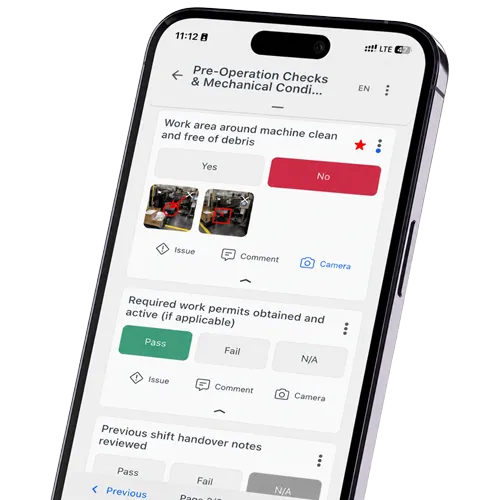
| Digital andon system | Links trigger, display, escalation and audit trail into one chain. | Operators, shift leads and maintenance | Only as good as the response times defined behind it. |
What is the most common failure point with andon?
Nobody agreed who answers, and by when. The call goes out, someone acknowledges it, the lamp resets, and the same station calls again next shift.
Shigeo Shingo made the point decades ago: the signal is worth far less than what the team does with it. Two habits close most of the gap. Agree a target for mean time to acknowledge per zone and post it where the crew can see it. Then treat a second call from the same station as a reason for root cause analysis, not a second reset.
Free Andon Call Log
One sheet per shift: every call, who responded, the minutes lost, plus a short audit of your response standard. It records what happened on your line, which no answer box can do for you. Download the call log (PDF). Prefer it digital? Run this on phone, tablet or PC in flowdit.
Related Terms
- Poka Yoke – stops the defect that would otherwise trigger the call.
- Downtime – what an unanswered andon turns into.
- Just-In-Time – the other TPS pillar; thin buffers make a slow response expensive.
- Kaizen – repeat calls are its raw material.