Skip to content
 EN
EN  DE
DE  العربية



Downtime: What It Means, Planned vs Unplanned and How it Differs from Idle Time
Downtime is any period when equipment that should be running is not. It splits into planned downtime, which you schedule for maintenance or changeovers, and unplanned downtime, the breakdown nobody wanted. People also confuse it with idle time, when the machine is ready but has no work to do.
Why does downtime matter?
Downtime is one of the largest and most controllable losses in any plant, because every stopped minute is output you still pay for in labor and overhead. Left unmeasured, the same faults keep recurring, maintenance stays reactive, and both reliability and throughput slowly erode. Tracking downtime is what turns those hidden losses into a clear list of problems worth fixing.
What counts as planned and unplanned downtime?
- Planned downtime is on the calendar: preventive maintenance, a tool change, a scheduled clean.
- Unplanned downtime is the surprise: a breakdown, a jam, a fault that trips the line mid-run.
- You reduce planned downtime by working more efficiently, and reduce unplanned downtime by fixing the root cause.
- Both count against availability, so both belong in the same log.
How is downtime different from idle time?
The difference is the machine’s readiness. Downtime means the equipment cannot run: it is broken, in maintenance, or waiting on a fix. Idle time means the equipment is able to run but has nothing to do, usually a starved feed or a bottleneck upstream. Downtime is an equipment problem; idle time is a flow problem, and the fixes rarely overlap.
Why is downtime worth tracking to the minute?
Unmeasured downtime hides the real losses. Log every stop with a cause and you can see which failures cause the most lost hours, which feeds machine availability and the availability leg of OEE. A stop you never recorded is a stop you will pay for again.
Downtime vs idle time at a glance
The two states people log as the same thing, separated.
| Aspect | Downtime | Idle Time |
|---|---|---|
| Can the machine run? | No | Yes |
| Typical cause | Breakdown, maintenance, fault | No work, starved feed, bottleneck |
| Owner | Maintenance | Planning / scheduling |
| Fix | Repair, prevent recurrence | Balance the flow, feed the line |
| Hits | Availability | Utilization |
Free Downtime Log
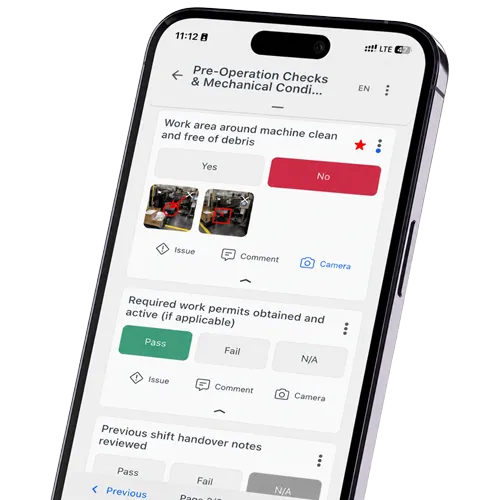
It records every stop with its start, end, cause and the action taken, so your biggest losses become visible. Download the checklist (PDF). You can also complete the checklist digitally in flowdit on your phone, tablet or PC.
Related Terms
- Mean Time to Repair (MTTR) – how long the average repair takes.
- Preventive Maintenance (PM) – planned work that cuts unplanned downtime.
- Manufacturing Asset Management – keeps the assets that go down running.
- Changeover Time
Further Reading
- Maintenance Management Software (CMMS) – maintenance digital
- Common Causes of Equipment Failure – what puts machines out of service
- Reducing Mean Time to Repair – shortening the outage
- Maintenance Metrics and Benchmarks – measuring availability