Skip to content
 EN
EN  DE
DE  العربية



Poka-Yoke: What It Is, the Types and How It Differs from Inspection
Poka-yoke is Japanese for mistake-proofing: designing a task so the error can’t be made, or can’t pass unnoticed. A connector that only fits one way is poka-yoke. It differs from inspection, which catches the mistake after it’s made. Poka-yoke stops it at the source.
Why is poka-yoke important?
Poka-yoke matters because it removes the chance for human error instead of relying on people to stay perfect, which is the cheapest and most dependable way to prevent defects. Building mistake-proofing into a task reduces scrap, rework and inspection effort and supports a first-time-right approach to quality. It is one of the most practical tools in lean production and continuous improvement.
What are the types of poka-yoke?
Mistake-proofing works in a few recognizable ways:
- Contact: a shape or fixture that only allows the correct fit or orientation.
- Fixed-value: a check that the right number of parts or actions happened, like a count.
- Motion-step: a sequence that won’t let the next step start until the last one is done.
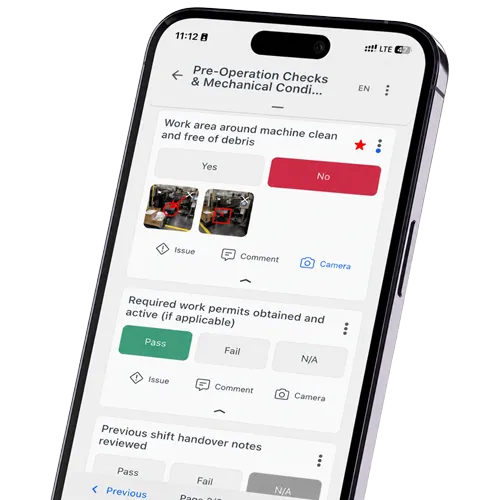
- Warning versus control: some poka-yokes alert the operator, the stronger ones simply prevent the error.
How does poka-yoke differ from inspection?
Prevent versus detect. Inspection, part of quality control, catches a defect after it’s made. Poka-yoke changes the task so the defect can’t be made, or can’t move forward undetected. Inspection depends on someone catching it; poka-yoke doesn’t depend on anyone. When a root cause analysis points at human error, a poka-yoke is often the real fix.
Poka-yoke vs inspection at a glance
Stopping the mistake versus catching it.
| Aspect | Poka-Yoke | Inspection |
|---|---|---|
| Acts | Before or at the error | After the error |
| Depends on | The design of the task | A person catching it |
| Result | Defect can't be made | Defect is found, maybe |
| Effort | Once, in design | Every part, every time |
Related Terms
- Digital Work Instructions – can build in step-by-step checks.
- Continuous Improvement Process (CIP) – where poka-yokes come from.
- Assembly Work Instruction
- Worker Assistance System