...

Best Checklist Software for Logistics and Transport

See flowdit in action

Schedule a live, one-on-one demo with a product expert and see how flowdit can help you go paperless and reduce costly unplanned downtime.

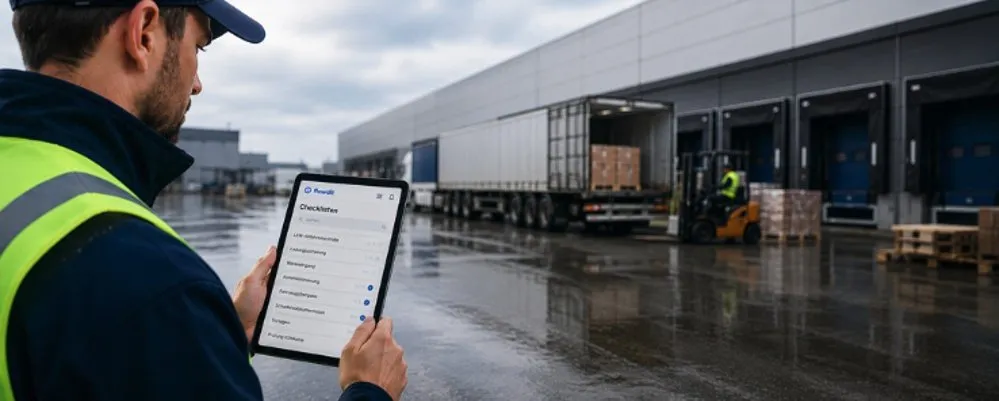
Man using checklist software for logistics and transport on tablet in warehouse

Summary: In 2026, the logistics industry faces the challenge of designing its processes to be efficient and error-free; all while dealing with growing international pressure. The question of how quickly and reliably information from vehicle inspections, goods receipts, or security checks can be processed is one that logistics and transportation managers, quality managers, and IT experts face every day. Paper-based processes and unstructured workflows are no longer viable for meeting these rising demands. So what are the key criteria for selecting the best checklist software for 2026? Which platforms offer the necessary flexibility, scalability, and real-time traceability to optimize operational processes and prevent errors? In this article, we’ll show you what features software solutions must offer to truly deliver in the hectic day-to-day of logistics.

Why Logistics Presents Unique Challenges

Logistics thrives on speed. At the same time, many risks arise precisely where time is tight: during vehicle inspections, goods receipt, load securing, handoffs, temperature checks, damage reports, or safety inspections in the warehouse. Paper lists and Excel files are of limited use in such processes. They are difficult to track, are often analyzed too late, and do not provide a real-time overview. This is particularly critical because numerous processes take place directly on-site in the warehouse or during transport and require immediate documentation.


Added to this is regulatory pressure: regulations such as ADR for hazardous materials transport, CMR freight law, or EU driving time regulations require complete documentation. Digital mandatory fields ensure that no step is skipped and automatically provide proof of inspection. At the same time, complexity is growing with global supply chains: many partners, locations, and process steps can hardly be reliably coordinated manually anymore.


Checklist software for transportation and logistics can be integrated into existing TMS, ERP, or inventory management systems, so that inspections, defect reports, and relevant process data are centrally documented and traceable in real time.


The actual need, however, runs deeper: Teams require an end-to-end process from inspection to corrective action.

Checklist Software or a Transport Management System?

A transport management system (TMS) manages shipping orders, routes, carriers, freight rates, shipment tracking, and scheduling. Checklist software, on the other hand, documents operational checks, statuses, deviations, and evidence directly within the process.


Both systems can complement each other: A TMS focuses on shipment tracking and the management of shipping orders. flowdit offers additional transparency by documenting the quality of inspection processes as well as the status of inspections and deviations in real time.


Current TMS comparisons show that transport management is heavily focused on planning, routes, carrier integration, and shipment control. For quality, safety, and inspection documentation, a specialized solution for digital checklists is therefore often required.

Still dealing with paper lists, Excel chaos, and a lack of tracking in your day-to-day transportation operations?

With flowdit, you can standardize inspections, driver checks, and logistics processes digitally and across all locations.

Typical Applications for Checklist Software in Logistics

Checklist software is used in logistics wherever inspection processes require documentation, are safety-related, or need to be repeatable. Here are some typical applications:

  • Vehicle and fleet inspections
  • Load securing
  • Container inspections
  • Inbound and outbound goods
  • Warehouse and 5S audits
  • Picking and packing
  • Temperature and cold chain controls
  • Hazardous materials and safety inspections
  • Damage documentation
  • Handover reports
  • Supplier audits
  • Maintenance and cleaning records

Functional Requirements for Checklist Software in Logistics Operations

Logistics processes place different demands on digital inspection and documentation systems than traditional office workflows. Inspections take place at loading docks, in cold storage areas, in yards, in warehouses, and on the road.

Mobile Use and Offline Capability

Inspections must be documented where they take place: on a smartphone or tablet, with or without a network connection. In warehouses, cold storage areas, workshops, transshipment points, or on the road, the connection is not always stable. Good checklist software must function offline and synchronize data later.

Photo documentation, signatures, and scanning

In cases of damage, missing seals, or incorrect loading, a simple checkmark is not enough. Photos, markings, comments, timestamps, digital signatures, and QR or barcode scanning provide legally compliant evidence.

Action tracking & escalation management

The biggest difference between a simple checklist app and a professional platform lies in tracking. When a defect is identified, it must automatically generate a task—complete with responsibility, deadline, status, and proof.

Standardized Templates

Logistics processes must be repeatable. Good templates assist with vehicle inspections, warehouse audits, incoming goods checks, safety inspections, and supplier audits. Even more importantly, however, companies must be able to adapt these templates to their own processes.

Interfaces and International Scalability

Multilingual support, location management, role-based permissions, a complete audit trail, and interfaces to SAP, Oracle, WMS, or TMS are not optional for larger organizations. Global rollouts require software that enforces process standards across locations.

Reporting, dashboards, and AI-powered analysis

Recurring patterns of deviations remain invisible without a structured database. AI-powered analyses make them visible and enable KPI-based control.

It is also important that inspections remain quick to perform, even under time pressure in the warehouse or at the loading dock. Good checklist software maps the actual workflow and not just the questionnaire.

The Best Checklist Software Solutions for Logistics & Transportation in 2026

In 2026, there are numerous solutions on the market, each offering different features and areas of focus. Choosing the right software depends on the specific requirements and processes within the company. While some software solutions focus on vehicle management, others concentrate on inspection and audit documentation. There are also platforms that cover all areas and offer an integrated solution.

Provider Software Category Features Integration Customer Support Price Per User Best Suited For
flowdit Digital Checklists & Inspections
  • Mobile Checklists
  • Digitizing Maintenance & Inspection Processes
  • Compliance Documentation
  • Real-time Reporting & Action Management
  • AI-powered Features & Workflows
API/ERP Integration (common in CMMS)* Support Center, Sales/Demo Price on Request (B2B Pricing) Digital Checklists & Maintenance Documentation
Lumiform Digital Checklists & Audits
  • Form Builder
  • Mobile Inspections
  • Workflow Automation
  • Reports & Analytics
API & Webhooks (Enterprise) Email, Live Chat, Add-on Phone From approx. €16/month per user (Pro plan) Checklists & Audit Management (mobile, compliance)
Maintastic Maintenance & Inspection Software
  • Maintenance Planning & Checklists
  • Asset & Task Management
(Integration common via interfaces - no public list) Email/Phone N/A publicly Maintenance & Service Management
AIS Alfaplan Transport Management Software (TMS)
  • Intelligent Route Planning
  • Real-time Telematics
  • Flexible Planning & Adjustment via a central interface
ERP/Warehouse Management, Telematics/Location, API/EDI interfaces, mobile apps Ticketing System, Hotline (weekdays), Remote Support, Training depending on contract No standard prices, project/size dependent, typically several thousand to five-digit € per year Freight forwarders & logistics providers with medium to large fleets, need for dispatch, route planning & real-time control
Route4Me Route Planning & Optimization
  • Automated Route Planning
  • Dispatch
  • GPS Tracking
  • Real-time Routing
ERP, CRM, e-commerce, TMS, Telematics Integrations Support Portal, Knowledge Base Price on request Last-Mile Routing & Route Optimization
SAP Transportation Management Enterprise Transport Management (TMS)
  • Transport Planning
  • Freight Costs
  • Shipment Tracking
  • ERP Integration
Deep SAP/ERP Integrations Enterprise Support (SLA) Price on request (Enterprise Pricing) Large, Complex Transport Processes
Fleet Board Telematics & Fleet Data Platform
  • GPS Tracking
  • Time Tracking
  • Driver Data
  • Mapping & Reports
OEM Telematics & Partner Integrations Online Support Center, FAQs Price on request Telematics, Vehicle & Driver Data
Spedion Telematics & Fleet Management
  • SPEDIONline Web Portal
  • Mobile App
  • Driver Hours & Rest Periods
  • ETA, Document Management
Integrations with TMS & Visibility Platforms Email, Phone, Wiki/Training Pay-per-use / based on usage Telematics & Vehicle Data Control
Transporeon Transport & Visibility Management
  • Transport Network
  • Flexible Modules
  • Data & TMS Connectivity
Transporeon Integrated App Program (API Framework) N/A publicly Usage-based Pricing Connected Transport Platform
Flowdit Logo

flowdit

flowdit is a mobile checklist and workflow platform that supports processes like digital inspections, maintenance, or operator duties directly on-site. The solution combines standardized checklists, action management, and offline functionality in one app. It is especially suited for operational teams with frequent inspection routines and seamless documentation.

Advantage: Consistently designed for mobile inspection and audit processes; clear task and issue tracking on-site.

Potential disadvantage: Not a classic transport or route management solution - focus remains on mobile checklists and operational inspection processes.

Focus: Mobile checklists, maintenance processes.

Lumiform Logo

Lumiform

Lumiform offers digital checklists, safety inspections, and audits with mobile execution, including photo documentation and action tracking. The platform is geared towards standardized inspection and audit processes.

Advantage: Easy creation and use of digital checklists for recurring logistics and safety processes.

Potential disadvantage: Lacks comprehensive functions for transport planning or TMS; more focused on audits and inspection processes.

Focus: Checklists, audits, inspection processes, and mobile inspections.

Maintastic Logo

Maintastic

Maintastic is a CMMS (Computerized Maintenance Management System) for digital maintenance planning, ticket and work order creation, and mobile maintenance. Technicians receive work orders, instructions, checklists, and asset information via smartphone or tablet; faults can be logged via QR code or voice input.

Advantage: Specifically developed for technical asset and maintenance processes - includes structured checklists, ticketing systems, and mobile operation.

Potential disadvantage: Not designed as a transport or route management tool; strength lies in maintenance and inspection processes.

Focus: Digitalized maintenance, inspections, checklists, and asset management in industry and intralogistics.

AIS Mobile Logo

AIS Alfaplan

AIS Alfaplan / proLogistik offers powerful transport management software (TMS) with features for route planning, freight optimization, and dispatch control for logistics companies and freight forwarders. It includes integrated telematics solutions that provide real-time vehicle and driver data for better process control and real-time transparency.

Advantage: Comprehensive transport planning and telematics integration enable efficient route optimization, vehicle tracking, and real-time communication between dispatch and drivers.

Potential disadvantage: More focused on operational transport processes and less on specialized checklist functions or audit management. It is better suited for larger logistics companies with complex freight and route planning systems.

Focus: Transport management, route optimization, real-time tracking, and telework for optimized logistics processes in medium and large fleets.

Route4Me Logo

Route4Me

Route4Me is a cloud-based routing and optimization platform for planning, sequencing, and managing delivery and transport routes. It generates optimized routes from multiple stops, supports real-time tracking, and offers mobile apps for drivers and dispatchers. Over 40,000 customers worldwide use the platform for last-mile organization.

Advantage: Strong, field-tested routing and dispatching function with real-time overview, mobile app, and flexible optimization parameters.

Potential disadvantage: Not a full TMS (e.g., freight billing, carrier management, or global supply chain functions) - focus is on routing.

Focus: Last-mile route optimization, dispatching, driver tracking.

SAP Transportation Management Logo

SAP Transportation Management (SAP TM)

SAP Transportation Management (SAP TM) is part of SAP's supply chain management portfolio and covers the entire transport process: from order capture to planning, tendering, freight selection, transport monitoring, and freight cost billing. The solution is deeply integrated with SAP ERP systems and is used for complex national and international transport processes.

Advantage: Seamless end-to-end mapping of logistics transport processes with full integration into SAP ERP landscapes.

Potential disadvantage: Implementation effort, complexity, and costs are significantly higher than those of specialized routing or mobile checklist tools.

Focus: Transport planning, order and freight management, monitoring, integration into supply chain.

Fleetboard Logo

Fleetboard

Fleetboard is a telematics and fleet management platform (particularly for commercial vehicles) that collects and visualizes vehicle and driver data in real time: driving times, rest periods, consumption analysis, performance reports, and direct sending of destination points to navigation systems. The solution is used by many commercial fleets to leverage telematics-based data for operational decisions.

Advantage: Deep vehicle and driver data collection; solid foundation for efficiency analysis and operational control.

Potential disadvantage: Not a full transport management system; main benefits lie in telematics data and fleet oversight, not in route planning or freight management.

Focus: Telematics data, driving behavior, vehicle monitoring, operational metrics.

Spedion Logo

Spedion

Spedion is a modular telematics and fleet management system with a web portal and mobile apps. Core functions include driving and rest time recording, tour and order status, communication between dispatch and driver, checklist tasks (e.g., departure inspections), and document and driver data management.

Advantage: Wide range of telematics features, including driver dispatch, document management, and task checklists.

Potential disadvantage: Not a classic TMS; route planning is more supportive and elemental than a comprehensive dispatch and transport management system.

Focus: Truck telematics, driver data, tour and task overview, mobile driver apps.

Transporeon Logo

Transporeon

Transporeon is a global logistics network platform that digitally connects shippers, freight forwarders, and carriers, supporting transport processes such as freight tendering, real-time tracking, and collaboration within the network. Acquired by Trimble in 2023, Transporeon aims to make transport cost, capacity allocation, and communication between partners more efficient.

Advantage: Connected platform for the logistics industry with a focus on collaboration between shippers and carrier networks.

Potential disadvantage: Not pure checklist or mobile app software; the benefits come into play in the network and partner context.

Focus: Tendering, freight exchange, network logistics, carrier coordination.

Selection Criteria for Logistics Software

Criterion Why it is important
Offline functionality In areas with poor reception, inspections and checks must be possible even without an internet connection
Mobile app Field staff and drivers need a mobile solution to capture data on the go and share it immediately
Photo documentation Damage, deviations, or defects must be documented immediately with photos to provide evidence
Action management Identified defects must be documented directly with assigned responsibility and deadlines to avoid delays and initiate solutions promptly
Audit trail All changes, data updates, and completed inspections must be stored in a traceable manner
Multilingual Support Essential for international and mixed teams
Reports The software should allow for exports (e.g., to PDF, Excel) to generate inspection reports or maintenance records
Templates Quick start for vehicle checks, warehouse audits, and handoffs
Integrations The software must be able to integrate seamlessly with existing ERP systems (e.g., SAP) or TMS
Scalability As the fleet grows or the number of locations increases, the software must be able to efficiently handle additional users, locations, and more complex processes
Route optimization Real-time analysis and optimization of routes saves costs and time, and also improves adherence to delivery times
Vehicle tracking Real-time monitoring of the entire fleet enables immediate detection of and response to irregularities
Temperature Monitoring Continuous temperature monitoring is essential when transporting perishable goods
Compliance Management Compliance with regulations such as ADR, CMR, or EU regulations must be integrated into the software
Real-Time Notifications Immediate response to deviations such as delays or damage increases customer satisfaction

Common Misconceptions in Software Projects

Selecting the right software solution for logistics and transportation is often complicated by misconceptions that lead to inefficient processes and additional costs. Here are the most common mistakes and what is often overlooked:

1. Software is viewed as “plug-and-play”

It is often assumed that software solutions can be integrated immediately without any customization. In reality, almost every solution requires extensive customization to integrate seamlessly with existing systems such as ERP or TMS.

2. Training requirements are underestimated

User-friendliness may be important, but even the most intuitive software requires thorough training. Without it, errors and inefficient use quickly arise.

3. Long-term scalability is ignored

Many companies consider only their current needs and choose solutions that cannot keep pace with growth. This leads later to costly migrations and inefficient processes.

4. Real-time data and mobile use are neglected

Software that does not enable real-time data processing or mobile use is inadequate in logistics. Immediate data capture is crucial, especially for goods receipt and vehicle inspections.

5. Reliance on standard solutions

Standard software often does not cover all of a company’s specific requirements. If customization options are lacking, this leads to inefficient processes and unnecessary additional costs

Predictive Logistics: AI Identifies Risks in Transportation & Logistics Earlier

Logistics processes often fail because problems aren’t identified until it’s too late. Driver checks are skipped, damage isn’t reported until it reaches the recipient, and discrepancies are added manually. This costs time, money, and, in some cases, the customer relationship.


Intelligent inspection workflows solve this differently. Drivers, warehouse staff, and field service personnel document directly on-site: mobile, offline-capable, with photos and mandatory fields that ensure completeness. Damage is recorded as it occurs, rather than after it escalates. Intelligent image analysis using AI automatically detects damage during vehicle inspections and goods receipts and triggers follow-up actions without manual assessment and without media discontinuity.


The result is more than just documentation. Every completed inspection step delivers structured data: when, where, who, what deviates. This database reveals patterns, recurring damage locations, conspicuous routes, and critical handover times. Forecasts replace reaction. That is Predictive Logistics in practice.

flowdit: From Checklists to a Resilient Supply Chain

Unstructured documentation processes are among the most common causes of quality issues in logistics and transportation. Missing documentation, inconsistent inspection standards, and delayed damage reports create operational risks that directly impact costs, liability, and customer satisfaction.


Form apps meet basic requirements. However, operational scaling, cross-location standardization, and audit-proof documentation require software designed for complex operational processes.


flowdit is designed for precisely these operational requirements: mobile inspections, offline use, photo evidence, action management, role-based permissions, multilingual support, and system integration: all in a single platform. For companies that want to use checklists as part of a seamless quality and documentation process.


Resilient supply chains are based on processes that can be documented, evaluated, and controlled in a standardized manner in real time.


Do your teams work with Excel spreadsheets, form apps, or paper checklists, but are hitting limits when it comes to scalability and traceability?


flowdit will show you in a personal demo how you can simplify and standardize your workflows.

FAQ | Checklist Software in Logistics & Transportation

Checklist software for logistics and transportation digitizes inspections, checks, and documentation in operational processes. This includes vehicle inspections, warehouse audits, incoming goods inspections, load securing, damage documentation, and safety inspections. The software replaces paper checklists and makes results, photos, non-conformities, and corrective actions centrally traceable.

Digital checklists standardize inspection processes so that critical steps cannot be skipped. Required fields, photo documentation, barcode scans, and automatic escalations prevent common issues such as incorrect goods receipts, missing batch information, or incomplete vehicle inspections. At the same time, they generate traceable process data that allows recurring sources of error to be identified and resolved more quickly.

Every inspection step is digitally recorded and documented in an audit-proof manner. Companies can track exactly when a vehicle was inspected, a shipment was checked, or a defect was reported. Discrepancies become visible and comparable. This creates a solid data foundation for audits, compliance requirements, and process improvements.

The inspection must be conducted directly on the vehicle using a smartphone or tablet and must not require any subsequent paperwork. Mandatory fields, photographic evidence, and automatic blocking mechanisms for safety-critical defects are recommended. Good systems also automatically record mileage, driver assignment, and timestamps.

Vehicle inspections, PPE checks, hazardous materials inspections, orramp safety checks are recorded on-site and stored centrally. Critical defects can be automatically escalated or directly linked to corrective actions. This reduces liability risks and improves the ability to provide evidence in the event of incidents. This is particularly relevant during audits, regulatory inspections, or insurance claims.

Temperatures are recorded manually or automatically via sensor integration and directly assigned to the transport order. Deviations trigger immediate alerts or escalations. This makes it significantly easier to demonstrate compliance with HACCP and GDP requirements. Seamless documentation throughout the entire cold chain is critical in this regard.

The app stores inspections locally on the device and automatically syncs them when a connection is available. This is crucial for underground parking garages, remote warehouses, or international transport routes with unreliable network coverage. Without reliable offline functionality, many rollouts fail even during day-to-day operations.

QR codes, NFC, andbarcodes link inspections directly to vehicles, gates, load carriers, machines, or storage locations. This reduces the time spent searching and prevents inspections from being assigned to the wrong object. This unique identification is particularly helpful for forklifts, trailers, containers, or racks. In practice, this significantly improves data quality.

The software ensures that safety-related inspections are conducted regularly, thoroughly, and in a traceable manner. These include vehicle inspections, forklift inspections, ramp inspections, PPE inspections, and safety walkthroughs. Critical defects can be immediately reported to the responsible parties. This ensures that occupational safety is not only documented but also actively managed.

Typical metrics include processing time, error rate, audit score, time to resolution, and response time to deviations. Many companies also improve their first-time-right rate and reduce complaints.

Marion Heinz
Editor
Content writer with a background in Information Management, translating complex industrial and digital transformation topics into clear, actionable insights. Keen on international collaboration and multilingual exchange.

Share post: