Skip to content
 EN
EN  DE
DE  العربية



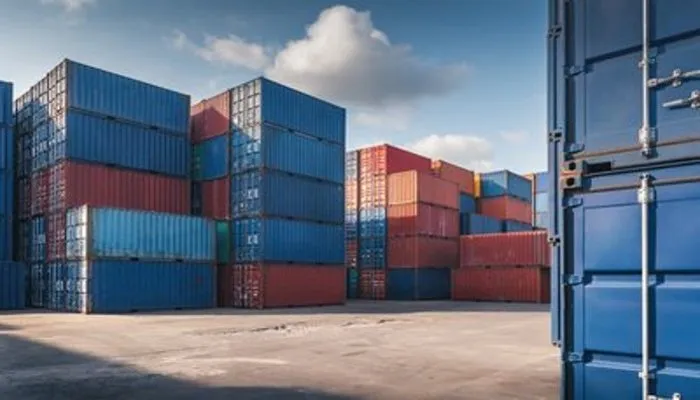
Summary: Containers fall over. Roofs tear open. Stacks tip over. Terminal managers, maintenance managers, and fleet managers know the consequences of inadequate inspections: downtime, liability claims, and accidents.
A container is not a storage room. It is a transport unit exposed to high mechanical loads during lifting, stacking, transport, and storage. Cracks in corner fittings, rusted floors, or defective locks lead to damage that can be avoided.
The CSC (International Convention for Safe Containers) and applicable technical standards require regular inspections. Not fulfill obligations, but because every container is repeatedly exposed to extreme forces in ports, depots, construction sites, and transport chains. This article explains what is inspected, who is authorized to inspect, how inspections are documented, and which international and regional rules apply. Without detours. With a checklist, clear intervals, and a structured inspection logic.
What is an ISO Container Inspection Checklist?
An ISO container inspection checklist is a standardized inspection and documentation tool used to assess the structural integrity, functional condition, and operational safety of an ISO container before it is released for transport or use. ISO containers are standardized steel transport units designed for global maritime, road, and rail transport. Constant handling, weather exposure, and mechanical stress accelerate wear over time.
The checklist replaces subjective visual checks with a reproducible inspection process. It determines whether a container is structurally intact, load-bearing, weather-tight, safe to operate, and suitable for the intended cargo. Damage, deviations, safety-relevant defects, and function-critical issues are documented in a traceable manner.
Beyond container structure, functional components (doors, locking rods, gaskets) and technical systems (reefers, tank containers) are inspected.
➤ The checklist forms the basis for release or rejection decisions before loading, during terminal handover, and within safety, quality, and compliance processes.
Importance of Container Inspections
Container inspection is crucial, because containers are used worldwide as safety-critical means of transport, often under harsh and unpredictable conditions. A documented inspection ensures that people, goods, and infrastructure remain protected.
Safety of personnel and infrastructure
Damaged floors, deformed corner fittings, or corrosion can lead to accidents during handling, stacking, or transport.
Protection of cargo
Cracks, leaky doors, or structural weaknesses can compromise the integrity of goods, particularly for sensitive or high-value goods.
Regulatory and contractual compliance
Inspections are required under the CSC Convention, ISO standards, port regulations, and applicable occupational safety rules. Missing or invalid inspections can lead to liability and insurance issues.
Avoiding business interruptions
Containers rejected at the gate or blocked by terminals cause delays, rehandling, and additional costs.
Traceability and audit security
Clear inspection records provide transparency for authorities, customers, insurers, and auditors.
➤ Container inspection is not an administrative exercise. It is a core element of secure logistics processes and legal protection.
Need reliable, audit-ready documentation for ISO container inspections?
Digital checklist software automates compliance reporting with full data integrity and transparency. Get started.
Inspection Intervals: When Do Containers Need to Be Inspected?
Inspection intervals for shipping containers depend on container type and the applicable international regulations. While standard freight containers are governed primarily by CSC (Convention for Safe Containers) rules, special container types like tank, refrigerated, or offshore containers are subject to additional or different requirements.
Standard Containers (Dry Containers)
- Initial inspection: No later than 5 years after manufacture
- Recurring inspection: Every 30 months or continuously under an ACEP (Approved Continuous Examination Program)
- Additional inspection: After accidents, repairs, or structural damage
Tank Containers
- Initial inspection: After manufacture and before commissioning
- Recurring inspection: Every 30 months
- Internal inspection: Typically every 5-6 years, depending on the container construction type and cargo
Reefer Containers
- Initial inspection: No later than 5 years after manufacture
- Structural inspection: Every 30 months or using the ACEP procedure.
- Electrical inspection: Not globally standardized; often performed annually according to manufacturer or operator requirements
Offshore Containers (e.g. DNV 2.7-1 / EN 12079)
- Initial inspection: After manufacture and before operation
- Recurring inspection: Annual visual inspection
- Major inspection: Every 4-5 years and main inspection every 4-5 years.
- Color Coding: Commonly used for inspection year identification in offshore operations
Local regulations, terminal rules, or contractual requirements may impose stricter intervals without altering CSC validity.
Gate Inspection in Practice
Gate inspections are typically performed when containers enter or leave a terminal, or during handover between operators, shipping lines, and transport providers.
The inspection is carried out directly at the container’s storage position under real operating conditions. The objective is to identify damaged or unsafe containers before they are released for loading, onward transport, or return.
Inspectors examine structural elements, functional components, markings, and approvals according to a defined inspection process. Any findings are documented immediately to ensure unsafe containers are removed from circulation at an early stage.

What to Inspect: A Complete Container Checklist
A comprehensive ISO container inspection checklist thoroughly addresses all key safety, structural, and documentation aspects of the container. It involves inspecting critical load-bearing and functional components, as well as the container's floor, securing devices, and markings. Compliance with relevant standards such as CSC and ISO 6346 is also verified.
The checklist ensures a detailed documentation of inspection results, identification of any defects, and necessary corrective actions. This process allows for complete traceability of the container's condition, making it easy to audit at any time.
Legal Requirements for Freight Container Inspection
Container inspection requirements are derived from international conventions, technical standards, and national occupational safety and hazardous goods regulations.
CSC Convention - International Legal Basis
The CSC Convention (International Convention for Safe Containers) is the central legal framework for all ISO containers in international transport. It is administered by the International Maritime Organization (IMO).
- Every ISO container used in international transport must carry a valid CSC plate with a verifiable inspection date.
- Structural integrity required for stacking and lifting loads must be verified through the ACEP system (Approved Continuous Examination Program) or periodic inspections (typically every 30 months).
- Containers without a valid CSC approval are not accepted for international transport.
Technical Standards and National Safety Regulations
In addition to the CSC Convention, ISO standards define minimum design and safety specifications for freight containers. These include:
- ISO 668 (container dimensions)
- ISO 1161 (corner fittings)
- ISO 1496 (structural requirements)
In addition to international conventions, national occupational safety laws and company-specific safety guidelines also apply to container inspections, varying by country and region.
➤ Before each use, a visual inspection for deformation, corrosion, sharp-edged damage, and proper functioning of the door locks is required.
Dangerous Goods Transport
For dangerous goods transport, additional regulations apply:
- The IMDG Code (International Maritime Dangerous Goods Code) governs the transport of dangerous goods by sea.
- ADR/RID regulations apply to land transport, specifically regarding road (ADR) and rail (RID).
➤ These require verification of tightness, cleanliness, correct labeling, and full documentation. Non-compliance with dangerous goods regulations can result in fines, transport bans, loss of insurance coverage, and personal liability for damages.
International Differences in Container Inspections
While containers are generally built according to uniform global standards, the inspection requirements and evaluation criteria can vary significantly by region. These differences primarily concern inspection intervals, the level of detail in documentation, and the acceptance of repairs, rather than the container’s construction itself. Regional standards such as the US IICL (Institute of International Container Lessors) guidelines, Chinese CCS (Container Certification System) requirements, and the European ADR (Agreement concerning the International Carriage of Dangerous Goods by Road) regulations are especially relevant in this context.
In practice, this means that a container may be technically functional but assessed differently depending on the region. These regional differences can have direct implications for approval processes, repair obligations, and the risk of delays.
| Region / Group | Inspection Standard / Institution | Inspection Focus | Inspection and Control Practices | Typical Characteristics |
|---|---|---|---|---|
| North America (USA, Canada) | Institute of International Container Lessors (IICL), CSC, ISO 9001 | Structural integrity, repair quality | Regular technical assessments, sometimes shortened intervals for leased containers | High repair standards and leasing quality requirements |
| Europe (EU) | ADR / RID / IMDG Code, CSC, ISO 14001, ISO 9001 | Hazardous goods and operational safety, environmental management | Regular inspections, additional certifications for tank containers | Close integration with safety regulations and liability law |
| China and Asia | China Classification Society, National Port Authorities, ISO 6346 | Export capability, safety, container labeling | Event- and port-dependent inspections | Extended documentation requirements, stringent hazardous goods inspections |
| Middle East (UAE, Saudi Arabia) | National Port Authorities, Customs Authorities, GSO Standards | Import control, safety compliance | Additional port inspections upon arrival | High sensitivity for security-critical containers |
| Global Maritime Traffic | IMO (ISPS Code), CSC, ISO 6346 | Basic structural safety, security measures | Proof via CSC plate or ACEP, security inspections | International minimum requirements with national interpretation |
Typical Defects Found During Container Inspections
Years of audit experience have identified recurring defects:
Critical defects (Container Not Operational)
These defects render a container unsafe or unfit for use:
- Rust Through of the Floor Cross Members: The most common cause of total structural failure. Particularly critical in older containers or those that have been poorly maintained.
- Cracks in Corner Fittings: Caused by material fatigue or improper handling during crane operation.
- Missing or Illegible CSC Plates: Containers without a valid, readable CSC (Convention for Safe Containers) plate are prohibited from international maritime transport.
- Deformed Corner Posts: Typically caused by collisions or overloading, compromising stackability.
- Continuous or Load-Bearing Damage to Floorboards: Risk of cargo breaking through or injuries during loading operations.
Moderate defects (Repair Required)
These defects require attention but do not necessarily render the container immediately unsafe:
- Leaky Door Seals: Leads to water ingress, potentially damaging cargo.
- Defective Door Locks: A safety hazard during transport.
- Corrosion on Side Walls: Can lead to structural weaknesses over time.
- Damaged Lashing Points: Impairs the securing of cargo, posing a risk during transit.
- Expired CSC Test Date: Container may not be used in international transport until it has been successfully retested.
Minor defects (Observation Recommended)
These defects should be monitored and addressed as part of regular maintenance:
- Superficial Dents in the Roof: No immediate concern unless leakage is present.
- Minor Paint Damage: Should be repaired promptly (corrosion protection).
- Worn Floor Markings: Can make identification more difficult.
Documentation Requirements and Retention Periods
In accordance with international standards and national regulations, maintaining accurate inspection documentation is essential for ISO containers in ports. The following details must be recorded:
Inspection Log/Inspection Report
- Name of the inspector
- Date of inspection
- Type of inspection (initial, recurring, extraordinary inspection)
- Result of the inspection
- Defects found
- Actions taken
- Next inspection date
Retention Obligation
Documentation must be retained at least until the next recurring inspection. Retaining inspection records for up to 5 years is recommended, especially with regard to liability and damage issues.
CSC Inspection Report
- Report in accordance with CSC specifications
- Documentation of identified damage (e.g., photos)
- Repair logs
- Renewal of the CSC sticker upon passing the inspection
Best Practices for Documentation
- Photographic evidence: Especially for critical or safety-related damages
- Clear assignment: Ensure documentation is linked to the container number
- Digital archiving: For quick access during audits
- Audit-proof storage: To ensure changes are traceable
- Location recording: Ensuring the location of the container is documented
Common Mistakes During Container Inspection
❌ CSC sticker not checked
Valid CSC (Container Safety Convention) certification is mandatory under transport law. Expired or missing stickers will result in rejection at terminals and may incur demurrage charges.
❌ Inadequate chassis inspection
Corrosion on corner fittings, cross members, and sills is often overlooked. Moisture accumulates in the floor area in particular, causing structural damage and impairing stackability.
❌ Documentation gaps
Missing or incomplete inspection reports make damage claims considerably more difficult. Without complete documentation of the condition, recourse claims against lessors or previous users are practically unenforceable.
❌ Inconsistent inspection criteria
Inspections should be based on IICL (Institute of International Container Lessors) standards or comparable norms. Subjective assessments without defined damage categories lead to disputes when returning containers or reporting damage.
❌ No light inspection with closed doors
Pinholes and microcracks remain invisible when viewed from the outside, but lead to moisture ingress and condensation.
❌ Door mechanism only visually inspected
Signs of wear on locking bars, rubber seals, and hinges only become apparent under load. Multiple opening/closing under pressure is necessary.
➤ A standardized checklist in accordance with IICL/ISO specifications is essential for legally compliant inspections.
Less Rework for Container Inspections with Mobile App Solutions
Paper-based container inspections systematically generate rework: illegible handwriting, missing mandatory information, media breaks during data transfer, subsequent clarifications of incomplete damage descriptions.
A mobile inspection app such as flowdit eliminates these inefficiencies directly at the point of inspection. Structured input masks with mandatory fields prevent incomplete documentation. Photos are immediately assigned to the correct damage type. Container numbers are scanned instead of typed. Digital data entry goes directly into the system without transmission errors.
The result: inspection reports are complete and usable when leaving the terminal. No queries to inspectors, no subsequent interpretation of illegible notes, no delays in scheduling. There is no need for rework.
Alongside mobile checklists, AI-powered audit approaches are gaining increasing importance for early risk detection and management across entire supply chains.
Mobility at the Point of Inspection
Inspectors are physically at the container: at the terminal, in the depot, or on the quay. No one carries a laptop through container yards. A smartphone or a rugged tablet is the only practical device for on-site inspection.
Direct on-site inspection
Inspectors work directly on the container using a smartphone or tablet. Paper forms and subsequent office work are eliminated.
Barcode and QR code scanning
Container IDs and CSC label numbers are scanned instead of typed. This reduces input errors and immediately verifies whether the container exists in the system.
Integrated camera documentation
Damage, seal numbers, CSC stickers, and container numbers are recorded via camera. Photos are directly assigned to the container and damage category, complete with time stamps and GPS coordinates.
Offline capability in terminal environments
The app works without an internet connection and synchronizes data automatically once connectivity is restored.
Real-time alerts for critical findings
If a container is classified as unsafe for transport, the dispatch department is notified immediately to prevent incorrect bookings.
Central transparency across all locations
Inspections from different terminals are visible in real time. Expired CSC approvals or structural damage are detected immediately.
Automatic report generation
Inspection reports are generated instantly after the inspection is completed, eliminating the need for office work later.
Geolocation verification of inspections
GPS data proves that inspections took place at the specified location, supporting audit and documentation requirements.
Quality control and auditing
Inspection duration, completeness, and anomalies can be evaluated centrally. Implausible patterns become visible.
Compliance and legal protection
Structured inspection protocols support compliance with the CSC Convention, IMDG Code, and local regulations. Time-stamped, GPS-verified documentation with digital signatures provides legally robust evidence.
Integration into existing systems
Seamless connection to warehouse management, ERP, or maintenance systems ensures consistent end-to-end processes.

Container Inspection Software: What Should Port Operators Look For?
For port operators, selecting the right software for container inspections is a critical factor for safety, efficiency, and legal compliance. Inspection processes must function reliably under real-world port conditions, clearly document any damage, and provide a transparent basis for decision-making. Software solutions for logistics and transportation offer an efficient and legally compliant solution to these requirements.
✔️ CSC and DGUV compliance
The software must fully support all mandatory inspection points in compliance with relevant international industry standards such as CSC and DGUV.
✔️ Real-time Data Access
Real-time tracking of cargo, containers, and shipments is essential to enable immediate decision-making and operational control.
✔️ Multilingualism
Given the global nature of port operations, the software should support multiple languages (e.g., English, German, Spanish, French, etc.) to facilitate effective communication across international teams.
✔️ Integration with Existing Systems
The ability to integrate with current systems such as ERP, TMS, and WMS is essential for efficient workflows and streamlined operations.
✔️ Flexibility
Templates should be adaptable to specific operational requirements, such as additional inspection points for specialized containers (e.g., offshore containers or hazardous cargo).
✔️ Reporting
It should provide automated reports in industry-standard formats, such as CSC-compliant PDF reports, for easy documentation management and audit support.
✔️ Security
The software must include robust security features, such as data encryption and role-based access control, to safeguard sensitive operational data.
✔️ Ease of Use
The interface should be user-friendly to minimize the learning curve, enabling international teams to quickly adopt and use the system effectively.
✔️ Vendor Reputation and Support
Choose a vendor with a proven track record of reliability and quick support.
Still using paper or Excel for quality checks?
Standardize inspections, track actions, keep records.
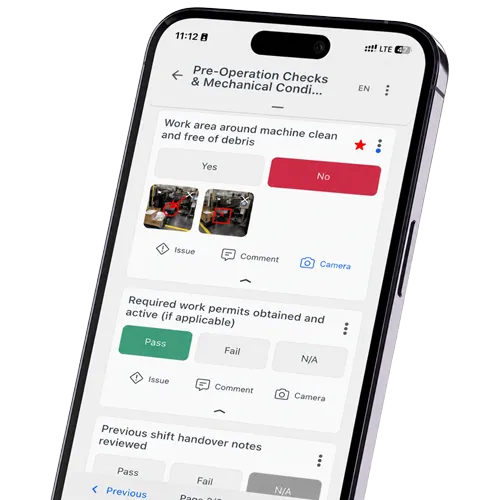
Digital checklists help to carry out container inspections in a structured, traceable, and uniform manner. Inspection results can be recorded directly on site, documented in an audit-proof way, and evaluated centrally.
flowdit offers checklist software that can be tailored to fit existing inspection processes, from gate inspections to recurring visual checks.
A non-binding trial in your own daily inspection routine will demonstrate whether digital checklists like flowdit are compatible with existing port operations.
FAQ | ISO Container Inspections
What are ISO containers?
ISO containers are standardized intermodal transport units built to the exact specifications set by the International Organization for Standardization (ISO). This means a container loaded in Shanghai will fit perfectly on a truck in Los Angeles or a train in Berlin. Designed primarily for transporting goods and products, they are constructed to withstand harsh weather conditions and other structural stresses throughout their operational lifespan.
Who is authorized to inspect containers?
Only qualified persons in accordance with DGUV Regulation 52. These persons must have training in CSC (Convention for Safe Containers) inspection and knowledge of ISO standards. In practice, these are often external experts or specially trained employees.
What happens if the inspection is not passed?
If a container fails the inspection, it will not receive a new CSC sticker and may not be used until the issues are addressed. The container must be repaired and re-inspected. In cases of significant structural damage, scrapping may be the more economical option. Failing to comply with these requirements could result in delays, increased costs, and potential safety hazards during transportation.
Can containers also be inspected before the 30-month period expires?
Yes, early inspections are useful for identifying potential issues, such as before a sale or when damage is suspected. However, they do not replace the official periodic inspection. The container must still undergo the required inspection every 30 months to maintain compliance with CSC and ISO standards.
How much does a container inspection cost?
The costs vary depending on the container type, scope of inspection, and location:
- Standard containers (20 ft/40 ft): approx. $100-$200
- Refrigerated containers: approx. $200-$350
- Tank containers: approx. $400-$800 (depending on additional inspection requirements)
- Offshore containers: approx. €500-€1,200
Additional costs for repairs and new CSC plates may also apply.
Do you also have to inspect your own containers?
Yes, containers you own must also be inspected if they are used as work equipment, such as storage containers on company premises. In this case, the inspection requirements of the Industrial Safety Regulation apply, supplemented by the relevant DGUV rules. Depending on the jurisdiction, container owners are responsible for conducting regular inspections or having them performed by authorized professionals.
What does the color of the CSC label mean?
Offshore containers use a color code system to indicate the inspection year, making it easier to identify when the next inspection is due.
- Green label: Container passed the inspection and is approved for use.
- Red label: Container failed the inspection and is not approved for use.
- Yellow label: Container is temporarily unfit until repairs are made and re-inspection is completed.
➤ For standard containers, there is no color coding. Instead, the printed inspection date on the CSC label is used to determine the inspection status.
Can a container inspection be carried out digitally?
Yes, digital checklists are permitted and offer considerable advantages: fewer errors, faster documentation, automatic reminders for re-inspections, and central data management. The prerequisite is audit-proof documentation with clear assignment of inspector, date, and inspection result. While digital inspections streamline the process and enhance accuracy, they must still comply with the same regulatory standards as traditional inspections, with certified professionals conducting or overseeing the inspections.
Image Credits
© Maha Heang 245789 - Adobe Stock
© Nina Lawrenson/peopleimages.com - Adobe Stock
© Nay - Adobe Stock