Skip to content
 EN
EN  DE
DE  العربية



Pre-Commissioning: What It is, the Steps, and Where Commissioning Takes Over
Pre-commissioning is the cold, powered-down check that runs after mechanical completion and before commissioning. You confirm the installed kit is clean, tight, aligned and safe to energize. Mechanical completion says it’s built; commissioning is where it runs live. Pre-commissioning is the bit in between that stops a bad start-up.
Why is pre-commissioning important?
Pre-commissioning is where you catch dirt, leaks, loose connections and miscalibrated instruments while the system is still safely powered down. Skip these cold checks and those faults surface once the plant is live, where they are slower, costlier and more dangerous to fix. Done well, it is what stands between mechanical completion and a clean, safe plant startup.
What are the steps in pre-commissioning?
Every step here happens with the power off. The point is to prove the system is safe to switch on:
- Cleaning and flushing: debris, weld slag and site dirt are washed out of the lines before anything runs through them.
- Pressure and leak tests prove the joints and welds hold before they ever see service.
- Calibration: every transmitter, gauge and valve is checked so it reads and acts correctly.
- Cold alignment work: rotating equipment and coupling clearances are set while everything is shut down.
- Continuity and loop checks confirm the wiring and control loops run end to end.
- Finally, every open defect goes on the punch list, so nothing is carried forward on a verbal promise.
Mechanical completion, pre-commissioning, commissioning: where’s the line?
Mechanical completion means it is installed to drawing, but nothing has been proven yet. Pre-commissioning proves it statically, with everything de-energized. Commissioning is where the power or process fluid goes in and the system runs for real, the next stage of the wider commissioning process. The line people miss is energization: the moment it goes live, pre-commissioning is over.
Where does pre-commissioning usually go wrong?
The usual failure is a punch list that lives on paper. Static checks get ticked, a few open items are carried into functional testing on a nod, and they resurface once the system is live, where they are slower and more dangerous to fix. A closed-loop punch list is the difference between a clean handover into post-commissioning and a start-up that stalls.
Where pre-commissioning sits in the handover
Four phases, and the one question that tells you which you’re in.
| Phase | Powered? | What it proves | What you get |
|---|---|---|---|
| Mechanical completion | Off | Built to drawing | MC certificate |
| Pre-commissioning | Off | Static checks pass | Closed punch list |
| Commissioning | On | It runs to spec | System accepted |
| Post-commissioning | Running | It performs in service | Operational readiness |
Free Pre-Commissioning Punch List
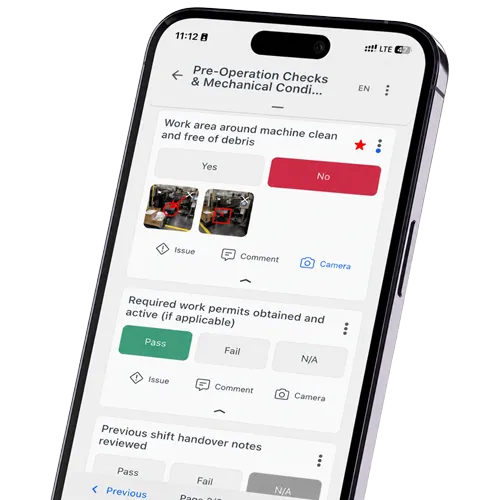
It separates the cold static items from the live ones and tracks each one through to closure, so nothing crosses into commissioning still open. Download the checklist (PDF). You can also complete the checklist digitally in flowdit on your phone, tablet or PC.
Related Terms
- Factory Acceptance Test (FAT) – vendor testing before it ships.
- Site Acceptance Test (SAT) – acceptance once it’s installed.
- Commissioning Plan – schedules the pre-commissioning work.
- Punch List – the open-items log itself.
- Operational Readiness – the state you’re heading for.
- Commissioning-Software– commissioning end to end
Further Reading
- Commissioning Management Software
- Plant Commissioning Process – what follows pre-commissioning
- Factory Acceptance Test Procedure and Report – testing before delivery to site
- Inspections During Commissioning – the checks in this phase