Skip to content

 EN
 DE
 العربية


Summary: Digital document management in commissioning links technical tests, supplier documents and approval workflows all the way to production release. flowdit supports the hands-on execution of FAT, SAT and functional tests, while DocuWare manages and releases the related documents. Together, the two systems give you a traceable basis for the start-up decision. What matters is that test results and document approvals are assessed side by side in a readiness review before the start date. Using a new production line as an example, the article also separates AI functions that are available today from future scenarios.
Why does commissioning decide the production start-up?
Every day between delivery and production release ties up capital in a line that earns nothing yet. The machine is paid for or financed, staff are scheduled, and follow-on orders are counting down to the start date.
The bottleneck is rarely the technology alone. Usually a certificate is missing, the revision level of a wiring diagram is unclear, or nobody knows which punch list items the supplier already reports as closed. Breaks occur at the handovers: engineering delivers documents at one revision level, the equipment builder tests against another, commissioning records deviations on paper, and production finally receives a binder that nobody has cross-checked. Each of these handovers involves a different company with its own filing system.
Our article on the commissioning process describes the sequence, and our article on plant documentation covers the as-built records. This article is about the point in between: the decision on whether the line may run.
What does a delayed production release cost?
A delayed release costs money in three places: lost contribution margin, labor costs without output, and tied-up capital. The calculation below uses freely chosen assumptions. They are neither market values nor customer data, so please enter your own figures for your project.
We assume a new line with an investment of €4,000,000 whose release slips by four weeks.
| Item | Assumption | Per week | Four weeks |
|---|---|---|---|
| Lost contribution margin | 2,000 units per week at €18 contribution margin after variable costs, no catch-up possible | €36,000 | €144,000 |
| Labor costs without output | 12 trained employees, €1,200 fully loaded cost per week and person | €14,400 | €57,600 |
| Additional external technician call-outs | 2 technicians, 5 days, €900 per day | €9,000 | €36,000 |
| Tied-up capital | €4,000,000 at 6% interest per year | €4,615 | €18,462 |
| Total | €64,015 | €256,062 |
Four weeks of delay cost around €256,000 in this example, roughly 6.4% of the investment. The largest item is the contribution margin. A permanent loss of contribution margin arises above all when the lost production cannot be made up later. There is no double counting: the contribution margin is calculated after variable costs, the labor costs in the example are fixed costs that are incurred even without production, and the cost of tied-up capital is an interest charge that is not part of the contribution margin. If wages are variable per unit in your case, they belong in the contribution margin and not a second time in the labor line. Contractual penalties, warranty issues and consequential costs at customers are not included.
How many days digital processes can save depends on the project, and there is no blanket figure for it. Still, the calculation shows what one week is worth in your project, and therefore how much effort a proper readiness review justifies.
Which steps make up digital commissioning, from FAT to trial operation?
Commissioning rests on four stages, and each one produces evidence that is needed later for the release.
- FAT (Factory Acceptance Test) at the supplier: The FAT checks the line at the manufacturer's plant before shipment against the test plan and specification. Anything found here should be fixed by the manufacturer and not carried over into the SAT. More in the article on the Factory Acceptance Test.
- Installation and pre-checks: Assembly, wiring and utility connections are in place, and functions are first tested without product.
- SAT (Site Acceptance Test) on site: The test takes place under real conditions. This is where wrong voltages, network conflicts and problems connecting to the controller show up, which could not occur at the supplier.
- Trial operation: The line runs with material. Performance verification, staff training and the list of remaining punch list items are produced now.
For automation systems in the process industry, DIN EN 62381 (IEC 62381) describes the sequence of factory acceptance test, site acceptance test and site integration test. In machine and plant engineering, the contract and the requirements specification define which criteria apply, and the standard serves as guidance.
In this context, digital simply means that measured values, photos, signatures and deviations are captured at the test point and do not have to be typed up in the evening.
When is the line really ready to start?
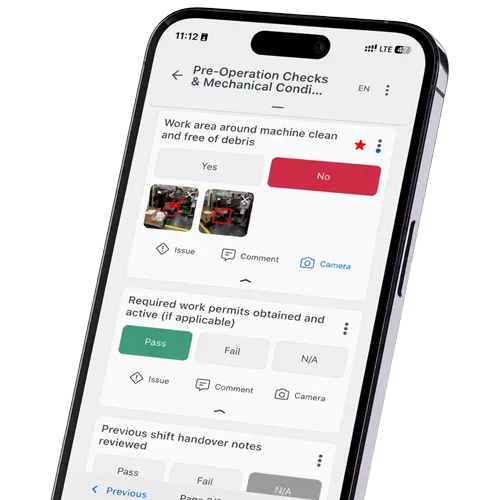
Inspect, close deviations and document acceptance: digitally with flowdit, right at the test point
How flowdit and DocuWare connect digital commissioning
flowdit supports the execution and documentation of commissioning, while DocuWare manages the documents that commissioning depends on and the documents that prove it. Each system keeps its own role, and that is exactly what makes the connection work.
flowdit: test, measure, follow up
flowdit is a no-code platform for inspections, audits, digital checklists and work instructions in industry and manufacturing. For FAT and SAT, the test steps are stored as templates. Depending on the scope of testing, they are separate or share common parts. The templates contain measurement fields with tolerance limits as well as photos and videos at the test point. The inspector works on a tablet or smartphone, offline if needed: the job is retrieved once with a network connection, and the sync runs automatically later.
If an item fails, the template can make a corrective action mandatory, with an owner and a deadline. Reminders continue until the action is closed (actions are available from the Premium plan). Signing happens on the device, and the signature appears in the report.
DocuWare: review, release, archive documents
Technical supplier documents such as wiring diagrams, drawings, test plans, certificates and operating manuals arrive in DocuWare and are indexed. A workflow routes them to electrical, mechanical and quality assurance for review, and revision levels are preserved. Readers who want to explore the topic in general can find it under DocuWare for the manufacturing industry. In the end, the acceptance records sit in the archive in an orderly way.
What the connection delivers
The interface between the two systems is a project-specific implementation and not a ready-made standard connector. reinstil sets it up, and the customer incurs no development effort. Standard in flowdit, by contrast, are the PDF report with the signature captured on the device and the data export as CSV, XML or JSON.
What the interface handles in the project: a completed test report goes to DocuWare without manual filing, with order, asset, batch and date as index values. This way it attaches to the right file. In the opposite direction, flowdit accesses the released revision of test plans, work instructions and drawings. The interface makes the most recently synchronized, released document version available at the test point. How often and to what extent synchronization takes place is defined in the project. One difference remains: flowdit also captures data offline, while DocuWare requires a connection, so offline the version from the last synchronization applies.
How delivery documents feed into testing and acceptance records flow back
1Delivery documents arrive
Circuit diagrams, drawings, test plans, certificates and operating manuals are indexed
2Review and release
Workflow with reviewers from electrical, mechanical and quality, version control, release history
3Test templates for FAT and SAT
The basis is the most recently synchronized, released revision. Depending on the scope of testing, separate or shared parts
4Testing at the test point
Measured values with tolerance limits, photos, deviations; tablet or smartphone, offline if needed
Corrective action on deviation
Owner, deadline, reminder (corrective actions from the Premium plan)
6Archive of acceptance records
The test report sits in the file, indexed by order, line, batch and date
5Test report with signature
PDF report, signature on the device, acceptance record for the file
Together, the two sides produce the digital commissioning file: test reports, released documents and punch lists in one place, each with its status and owner.
When is a line ready for production?
A line is ready for production when the technical evidence and the documentation evidence together meet the release criteria agreed in advance. If one of the two is missing, the decision is incomplete, even if the line runs without a fault.
Digital commissioning readiness management means putting both statuses side by side in a fixed review before the date. Criteria are set before the FAT, not on the day of release.
| Area | Technical evidence (flowdit) | Document evidence (DocuWare) | Release criterion |
|---|---|---|---|
| Function and performance | SAT measured values within tolerance, deviations recorded | Test plan in released revision | All mandatory test points passed; only items classified in advance as not relevant for acceptance may stay open with an action and a deadline |
| Punch list items | Open actions by priority and age | Agreed punch list | No item relevant for acceptance is open |
| Documents | Test report assigned to the asset | Wiring diagrams, declaration of conformity, operating manual and calibration records released | Handover list complete |
| Personnel | Training completed via checklist | Attendance record archived | Training documented for all shifts |
The review has three possible outcomes: Go, Go with conditions and No-Go. Conditions need an owner and a date, otherwise they are a deferred No-Go. Safety-relevant and other mandatory criteria are knock-out criteria: they must be met before release and cannot be replaced by an action with a later deadline. Which items count as mandatory is defined in the review before the FAT. People make the overall assessment in the review, and both systems provide the basis.
One clarification belongs here. A released document version is not a safety release. It replaces neither the safety acceptance nor the pre-commissioning inspections required by applicable laws, regulations and safety standards, nor any required approval by qualified personnel or authorized inspection bodies. It shows that the documents are complete and at the correct revision level.
Digital commissioning from punch list to handover.
Track open points, document progress, and hand over faster.
How do the systems work together on a new production line?
An example, explicitly hypothetical and without reference to any customer: a plant commissions a new assembly line with a conveyor section, a robot cell and a test station. An equipment builder supplies it, and production is due to start within a fixed time window.
- Before the FAT: The buyer defines the document list and acceptance criteria. Supplier documents arrive in DocuWare, and a workflow assigns them to the reviewers. The test plans for FAT and SAT are transferred into flowdit as templates, using the AI import, which reads Word, Excel or PDF files.
- FAT: An inspector from the buyer walks through the line at the supplier. Measured values with tolerances, photos and deviations are recorded at the test point. Two defects lead to actions for the supplier, which must be closed before shipment. Via the interface, the signed report is filed in DocuWare.
- SAT: On site, a dedicated SAT template is used, which takes over parts of the FAT test plan and adds installation and integration tests. The connection to the higher-level controller fails. This is a mandatory criterion: the action goes to the electrician with a deadline and must be closed before release. Reminders continue until the item is done.
- Readiness review: One week before the date, two lists are on the table. The action list from flowdit shows two open cosmetic items, and the document status from DocuWare shows that the declaration of conformity required for the complete line is missing. Result: No-Go until it arrives. The cosmetic items, which were classified in advance as not relevant for acceptance, continue as a condition with a date.
- Handover: Once the declaration has arrived and been released, the review closes with Go. Production and maintenance receive the commissioning file.
The point of the story: without the second list, the line would have started up even though the declaration of conformity required for the complete line was missing, and this would only have come to light at the next inspection.
How does the controlled handover to production and maintenance work?
A controlled handover starts with a list rather than a date. The list defines which documents at which revision level, which punch list items with which owner, and which training sessions with which proof belong to the handover.
Production needs operating instructions, recipes, parameter settings and fault procedures. Maintenance needs the asset master data, spare parts information and a maintenance plan. In flowdit, maintenance intervals can be set up with automatic follow-up dates (from the Standard plan), so the plan does not start from zero once the line is running. Which documents are stored permanently in which archive is a matter for document management, and the basics are covered in the article on document management in manufacturing.
The legal weight of the handover is increasing. From 20 January 2027, the Machinery Regulation (EU) 2023/1230 applies in place of the Machinery Directive 2006/42/EC. Operating instructions and the EU declaration of conformity are among the documents that manufacturers pass on to operators, and manufacturers must retain the technical documentation for at least ten years. For operators, this has a practical consequence: the handover should show which version they received.
Warranty periods usually start with acceptance. Anyone who later claims a defect against the supplier needs the status at acceptance as evidence.
International projects add further variables. The equipment supplier is based in another country, teams are spread across several time zones, and national regulations define acceptance differently. In flowdit, test templates are available in multiple languages: each inspector works in their own language, while measured values, deviations and actions come together in one shared dataset. All sites therefore work with the same released template version, and country-specific requirements can be added as additional test points or conditional questions. Which regulations apply at a given site is for the responsible local department to clarify, and the software does not replace legal review.
What can AI do in commissioning today, and what is still a future scenario?
What is available today is AI-assisted document analysis: it finds, compares and summarizes content. An automated completeness check is a different thing, and that is still a future scenario. In both cases, the release decision stays with people.
Available in flowdit: The AI import reads test templates from Excel, Word, PDF and photos of paper lists. A supplier's test plan becomes a digital template this way.
Available in DocuWare: According to DocuWare, the AI assistant Aura has been available to cloud customers in the new interface since November 2026, and DocuWare 7.15 is required. Aura finds, compares and summarizes, takes document content and index fields into account, and shows only what the user has access to. The chat searches only file cabinets that the administrator has enabled. Aura does not move files and does not automate workflows, and answer quality is not guaranteed for handwriting or poor OCR. DocuWare IDP can also extract information from documents without prior training.
For commissioning, these are examples of queries that can be asked this way:
- Which acceptance documents are missing for the production line?
- What are the differences between two revisions of a technical document?
- Which conditions were recorded in the acceptance report?
Aura answers the first question only on the basis of what is in the released document pool. If the list of agreed documents is stored in the archive as a document, it can serve as the comparison baseline. A person checks whether the answer is complete. Question two corresponds to the comparison that DocuWare describes for contract versions, and question three is a search with a summary.
Future scenario: An automated completeness check runs without a question being asked. It compares each delivery against the agreed document list, reports missing documents on its own and detects contradictions, for example when a test record names a different revision level than the released wiring diagram. The building blocks exist, but there is no ready-made standard procedure for commissioning. Whether an AI assistant can be connected to both systems depends on the IT landscape.
Where inspection and document release come together
FAQ | Commissioning Documentation
How can technical test results and document approvals be assessed together in a readiness review?
Before the FAT, the review sets the criteria and separates mandatory items from those that are not relevant for acceptance. On the day, two statuses lie side by side: test results and open actions from flowdit, and the approval status of the documents from DocuWare. Mandatory criteria must be met, and only the remaining items may stay open as a condition with an owner and a date. The outcome is Go, Go with conditions or No-Go.
Does a document release in DocuWare replace a safety acceptance?
No. The document release shows that the documents are complete and at the correct revision level. Safety approvals and legally required pre-commissioning inspections remain separate steps, carried out by competent persons or approved bodies.
Do I need DocuWare to use flowdit in commissioning?
No, flowdit can also be used on its own. Connecting the two pays off if supplier documents and acceptance records are already in DocuWare or are meant to be stored there.
When in the project should the document list be defined?
Before the order is placed. Format, revision level and delivery date of each document belong in the contract with the equipment builder, because what is written there can be enforced later.
Who decides on the production release?
Responsibility lies with the operator. In practice, the readiness review usually brings together project management, production, maintenance and quality assurance, and the plant or production manager gives the release.
What does digital handover mean?
It is the documented handover of the line from the equipment builder to production and maintenance, with a punch list, released documents and training records in one shared file instead of in binders and email threads.
Recommendations
- Document list in the supply contract: Define the scope, format and revision level of the supplier documents before the order is placed.
- Test templates before the FAT: Transfer the test plans for FAT and SAT as templates, agree tolerances and acceptance criteria in writing, and define which criteria are mandatory.
- Schedule the readiness review: Set it one week before the start date and bring the action list and the document status.
- Measure your baseline: In your next project, record the time from delivery to release and the number of open punch list items, even if not everything runs digitally yet.