Skip to content

 EN
 DE
 العربية


Summary: Grounds maintenance keeps the outdoor spaces of a property, from lawn and landscape to car parks, safe, usable and presentable. Facility managers, maintenance managers and grounds supervisors usually lose money in two other places: schedules that ignore climate and growth, and missing proof of what was done in which zone. This guide covers tasks, intervals by climate, contractor control and KPIs, and how maintenance software makes grounds work plannable and provable.
Key facts
- Frequencies prove visits: "Mow weekly" proves a visit. A target condition per zone, such as a grass height range, proves a result.
- Climate sets the calendar: The same task list needs different intervals in Oslo, Tokyo and a desert city. The critical season is winter in the north, the storm season in typhoon regions and summer in dry regions.
- Repeat findings in one zone point to a root cause: The third flooded corner in a quarter is a drainage problem, and another repair will not fix it.
- Proof needs place and time: A photo taken on site with timestamp and location settles most disputes with tenants and contractors in minutes.
- Grounds belong in the maintenance system: Mowers, pumps and irrigation controllers are assets with service intervals. Managed outside the maintenance software, they drop out of planning and reporting.
Still tracking grounds maintenance on paper?
Try flowdit to manage inspections and tasks on your phone.
What is grounds maintenance?
Grounds maintenance is the scheduled and reactive care of the outdoor areas of a property, including turf, trees, shrubs, beds, irrigation, paths, car parks, fences, drainage and outdoor lighting, to keep them safe, functional and in the condition they were designed for. On residential or commercial grounds, indoor planting such as atriums and green walls often falls under the same team.
Soft landscape means the living parts: lawn, trees, shrubs and beds. Hard landscape covers walkways, drainage, fences, benches and lighting. Irrigation sits between the two, and on dry sites it is often the largest single cost line.
| Term | Goal | Typical output |
|---|---|---|
| Landscaping | Design and build an outdoor space | New planting, paving, irrigation layout |
| Lawn care | Keep turf dense and healthy | Mowing, feeding, aeration, weed control |
| Grounds maintenance | Keep that space in its intended condition | Mowing, pruning, irrigation checks, repairs, inspections |
| Grounds management | Plan, contract and control the work | Budget, specifications, KPIs, contractor reviews |
Facility managers count grounds among the soft services, and organisations working to ISO 41001 treat them like any other service with defined requirements. For the wider picture, read our guide to facilities maintenance.
Where is grounds maintenance needed?
Every property with outdoor space needs it, but priorities shift with the site.
| Site type | What matters most |
|---|---|
| Offices, retail, residential communities | Curb appeal, car park safety, play areas, quiet work times |
| Industrial plants and warehouses | Clear fire access routes and hydrants, drainage, fence lines |
| Schools, campuses, hospitals | Accessible paths, sports fields, work outside busy hours |
| Parks, sports fields, golf courses | Large areas, playing surface quality, visitor safety |
On industrial plants, grounds work is part of fire safety: vegetation must not block escape routes, and fence lines need a clear strip.
What tasks are part of grounds maintenance?
Six task groups cover almost every site.
- Turf care: lawn mowing, edging, aeration, fertilising, weed control. A healthy lawn also needs worn patches repaired before they spread.
- Trees, shrubs and beds. Pruning, mulching and replanting beds are routine. Palm pruning usually runs as a separate task line because it needs a lift.
- Irrigation. Someone has to own the controller programs, while crews check sprinklers and drip lines, repair leaks and clean filters.
- Hard surfaces: sweeping, litter, drains, paving, fences, gutters and pressure washing.
- Pest, bird and weed control. Mechanical methods come first. Chemicals are the last step and need licensed staff.
- Equipment and safety items. Mowers, trimmers and pumps need servicing like any other asset, and trip hazards, lighting and play equipment get checked on a fixed round. Outdoor lighting, pumps and irrigation controllers are electrical assets, so their checks belong in the same plan as your electrical maintenance.
For daily rounds, our landscaping maintenance checklist covers turf, irrigation, fences and lighting and records grass height as a measured value. Adapt zones and intervals to your site.
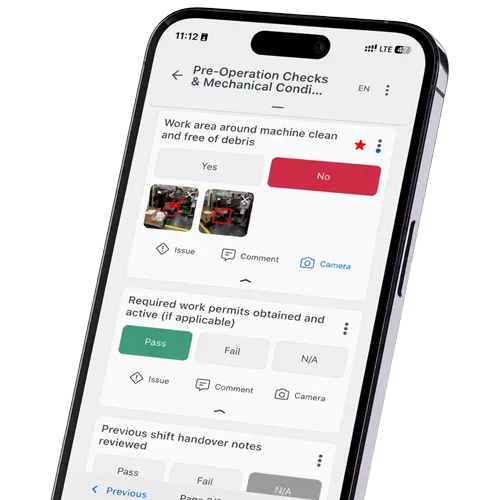
Still managing operations with paper and Excel?
Digitize inspections, audits, SOPs, and corrective actions.
Who does grounds maintenance?
Groundskeepers handle the daily lawn maintenance and litter rounds. Landscapers plant and redesign, arborists prune and assess trees, and on sports sites a turf manager answers for the playing surface. Larger teams add a grounds supervisor who owns rounds, budget and contractor checks.
Formal qualifications are rarely required, with one exception: pesticide application needs a licence in most countries, in the US under EPA certification rules. The Professional Grounds Management Society (PGMS) offers voluntary certifications for technicians and managers.
Which maintenance strategies apply to grounds?
Preventive maintenance programs run on a schedule, from the weekly mowing round to the yearly tree inspection. Corrective maintenance fixes what rounds or users report, such as a broken sprinkler head. Condition-based maintenance reacts to a measured value, for example a soil moisture sensor that holds back irrigation after rain. Predictive maintenance is still rare outdoors.
If most work orders on a site are corrective, the team is chasing failures. Our article on preventive maintenance shows how to shift that ratio.
How often should grounds maintenance tasks be done?
Growth, climate, irrigation and foot traffic decide the frequency. The table gives common starting points, to be adjusted after one full season of your own records.
| Task | Temperate | Cold, snowy winters | Humid, storm-prone | Hot, dry |
|---|---|---|---|---|
| Mowing | Weekly in season | Weekly in a short season | Weekly or more in the rainy months | Weekly most of the year |
| Irrigation check | Monthly | Monthly, drain before frost | Monthly, less in the rainy season | Weekly in summer |
| Hedge and shrub trimming | Two to four times a year | Once or twice a year | Every four to eight weeks | Every four to eight weeks |
| Drains and gutters | Quarterly, after leaf fall | Before winter, after thaw | Before the storm season, after every storm | After sand or dust storms |
| Snow and ice | When needed | Daily in winter, early morning | Rarely | Not needed |
How does climate change the grounds maintenance plan?
The task list stays almost the same worldwide. The critical season changes, and with it the main risk.
Cold winters (Scandinavia, Canada). Winter service is the core job. Paths and car parks have to be cleared and gritted early, and many municipalities hold owners responsible for adjoining footpaths. Irrigation lines must be drained before the first frost, and seasonal maintenance such as mowing, planting and repairs piles up in a short summer.
Humid, storm-prone climates (Tokyo, the US Gulf Coast). Rain drives growth, and drainage drives risk. Moss makes paving slippery. A blocked drain floods a car park in the first heavy shower, so before typhoon or hurricane season, crews thin crowns, brace young trees and clear every drain on site. Then, after each storm, a damage round follows, documented zone by zone for insurance.
Hot, dry climates (Middle East, US Southwest). Heat decides when people can work. The United Arab Emirates, for example, bans outdoor work from 12:30 to 15:00 between 15 June and 15 September. Water at night. Sites irrigating with treated sewage effluent also need regular filter and emitter checks, because clogged drip lines show up as dead patches within days.
Everywhere, drip irrigation, plants grouped by water demand and soil moisture sensors cut water use. Meter per zone where you can, or nobody knows which area drives the bill.
How do you check the work of a grounds maintenance contractor?
Specify outcomes, then collect proof per zone. A landscape maintenance contract that lists frequencies tells you the contractor visited, not whether the result is acceptable. An outcome-based specification describes the condition instead: grass height within a range, beds free of weeds above a certain size, no litter older than one day.
Proof then needs place and time:
- numbered zones that reappear on every work order and report,
- a photo per zone after the work, shot on the spot with timestamp and location,
- findings recorded as defects with an owner and a due date,
- a short sign-off by the site supervisor or client.
When a tenant complains, zone photos answer the question in minutes instead of a debate about what the lawn looked like last Tuesday.
Which KPIs show if grounds maintenance works?
- Schedule compliance shows the share of planned rounds done on time. If it stays low for weeks, the plan does not fit the crew size.
- Defect close-out time measures how long a finding stays open. Rising? Check capacity and spare parts.
- Repeat findings per zone reveal design faults and unsolved root causes.
- Water use per irrigated area is the figure management in dry regions asks about first.
What should grounds maintenance software do?
Spreadsheets hold schedules but prove nothing. Grounds care suits the same maintenance software you use for buildings and machines, provided it handles a few outdoor specifics:
- Recurring rounds per zone with automatic follow-up dates, so intervals do not depend on someone's memory.
- Mobile checklists that work offline, because car parks, roofs and remote fence lines often have no signal.
- Photo and location at the checkpoint, the core of contractor proof.
- Automatic follow-up tasks for every "not OK" answer, with reminders until the defect is closed.
- Assets with service history for mowers, pumps and controllers.
- Checklists in the crew's language, since international grounds crews rarely share one.
SMEs can start with one site and a few checklists. Groups with many sites use the same zone logic and get comparable results across countries. More on choosing a system in our overview of maintenance management software.
How do your crews prove grounds work today?
FAQ | Grounds maintenance
How much does grounds maintenance cost?
Contractors price per visit, per square metre per year or as a fixed annual sum. The main drivers are the share of irrigated turf, the number of trees and the required response time for defects. Ask for prices per zone to compare offers line by line.
Should grounds maintenance be done in-house or outsourced?
Specialist maintenance services such as tree surgery, pest control and irrigation design are usually outsourced, often to a landscaping company. Daily rounds on one large site are often cheaper in-house. Many facility managers combine both and keep the inspection role in their own team.
Should you hire landscaping services or a specialist lawn care service?
One full-service contractor means one contract and one party responsible when something fails. A specialist lawn care service pays off where turf quality is the product, for example on sports fields or prestige frontages. On mixed portfolios, many facility managers keep one main contractor and buy specialists through it, so the interfaces stay with the contractor and not with FM.
What belongs in a landscape maintenance service contract besides the specification?
A site map with clear scope limits, including who owns gutters, roofs and boundary strips. Response times by priority, a price list for extra work and proof of insurance and pesticide licences. A notice period and a performance clause that links payment to the agreed evidence complete the contract.
How do you hand over a site to a new landscaping company?
Walk the site together and photograph every zone before the first visit. That baseline shows the condition the new contractor took over. Hand over the irrigation plan, controller access and an asset list, then run joint inspections during the first month.
When does landscaping become a project instead of maintenance?
Keeping the existing condition is maintenance, usually paid from the operating budget. Redesigning areas, adding irrigation zones or new hardscape are landscaping projects with their own approval and often a capital budget. Check the split with your finance team, and add every new asset to the maintenance plan at handover.
How long does it take to digitise grounds inspections?
With a template and a zone plan, the first digital round can run the same day. Agreeing outcome standards with contractors is the slower part and takes a few weeks per site.
Recommendations and next steps
- Number your zones and use the same numbers in contracts, work orders and reports.
- Replace frequency-only specifications with target conditions, starting with turf and litter.
- Plan the critical season separately: winter service, storm preparation or irrigation and heat rules.
- Ask for dated, located photos per zone and a sign-off.
- Track four KPIs and review intervals after the first full season.