Skip to content
 EN
EN  DE
DE  العربية



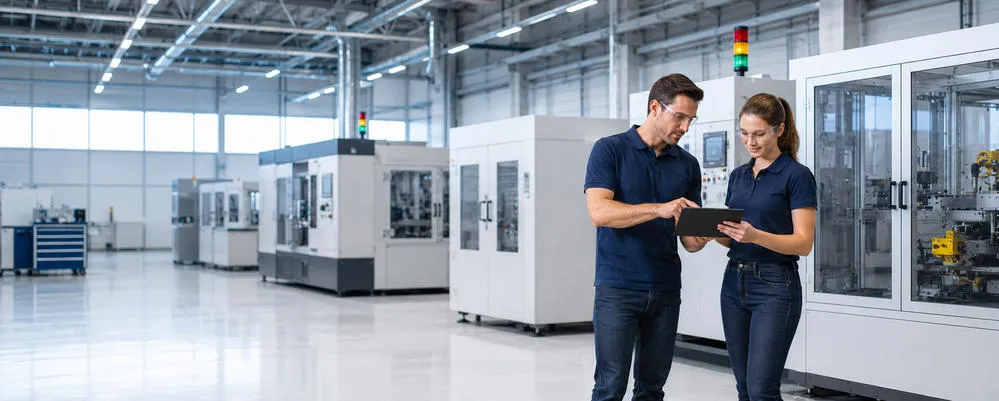
Summary: A communication system in manufacturing includes everything that moves information through the plant: the spoken channels used by people, the protocols used by machines, and the records that preserve information beyond the immediate interaction. Before Industry 4.0, much of this information flow depended on paper records and verbal handovers, often requiring information to be entered again manually between shifts or departments.
Four types of messages define what such a system must handle: status, instruction, deviation, and confirmation. These often travel through separate channels such as verbal communication, machine protocols, and written records. When they are not brought together, information can be delayed or lost, leading to slower decisions, delayed corrective action, more scrap, and avoidable production downtime.
Improving manufacturing communication therefore means deciding what must be spoken, what must be logged, who must act, and what should trigger a response without a human in the loop.
What is a Manufacturing Communication System?
A manufacturing communication system is the set of channels, rules and records that move operational information between people and the systems they work with. Radio vendors tend to equate it with voice hardware; that covers maybe a third of the picture.
Three layers carry the load:
- People to people: Shift handovers, escalation calls, andon requests, morning huddles, the conversation at the machine when something sounds wrong.
- Machines to systems: PLCs, sensors and controllers pushing state, counts and faults upward into SCADA, MES and historian.
- The record layer holds whatever survives after the shift ends: checklists, deviations, work orders, logs, sign-offs.
Across all three layers, four message types define the scope: status (what is running, what is down), instruction (what to do next), exception (something deviated from plan) and confirmation (it was done, here is the evidence). The technology underneath can be a radio, a mobile app, an andon board, a paper logbook, or all four at once.
Why Communication Systems Matter in Manufacturing
Production performance depends heavily on response time. If a machine develops a fault at 10:03 but maintenance only learns about it at 10:18, the technical problem may have affected production for 15 minutes longer than necessary.
The same principle applies to:
- quality deviations that continue into subsequent units
- missing material that stops an assembly process
- failed inspections that never reach quality management
- maintenance requests without machine context
- safety observations that remain in paper forms
- outdated work instructions still being used on the line
- shift information lost during handovers
These communication gaps directly affect productivity, downtime, scrap, rework, throughput, and the time required to resolve production issues in manufacturing environments.
A manufacturing communication system gets production issues to the right person with the right context, without delays caused by calls, paper forms or manual handovers. This shortens the time from detection to action, reducing downtime, rework and the risk of problems spreading through production.
Still relying on disconnected tools on the shop floor?
See how Connected Worker Software keeps people, processes, and information in sync.
Where Communication Breaks Down in Manufacturing
Manufacturing communication usually fails at the points where information has to move between people, systems, shifts or production processes.
1. Frontline workers are disconnected from the information flow
Operators often identify defects, material shortages or abnormal machine behaviour first. The challenge is getting these observations into maintenance, quality or production management in a structured and traceable form.
2. Information is fragmented across too many channels
Radio, paper, spreadsheets, email, messaging apps, MES and visual boards often exist in parallel. The problem is not the number of channels itself, but that no single record clearly defines the current and authoritative status.
3. Communication loses context
An alarm or short message alone is rarely enough to support a decision. Depending on the event, information such as the asset, order, batch, station, measured value, defect classification and responsible role has to remain attached to it.
4. Shift handovers lose unresolved information
Open deviations, temporary repairs, quality holds and unfinished maintenance work are particularly vulnerable during shift changes. If their status and next required action are not preserved, the incoming shift starts with an incomplete picture.
5. Too many alerts create communication noise
Modern factories can face the opposite problem to insufficient communication: too much unprioritised information. When routine warnings and critical events compete for the same attention, operators are more likely to overlook the messages that actually require action.
6. Human and machine information remain separated
A PLC or MES may show that a machine stopped, while the operator knows why, maintenance knows what was repaired and quality knows which products were affected. If these pieces remain in separate records or conversations, no one has the complete production event.
The Main Communication Flows in Manufacturing
Five flows carry everything that moves through a plant. Each has its own requirements on timing and ownership, and each fails in a different way.
Machine-to-machine (M2M)
Equipment talks to equipment with no human in the loop. A conveyor signals the next station that a part is arriving. A robot takes position data from a vision system. Two PLCs synchronize a movement across a cell. What these paths need is low latency, deterministic timing and failure rates close to zero. They belong close to the process. Basic machine operation should not depend on a cloud service or a WAN link, because a network outage then becomes a production stop on the factory floor
Machine-to-system
At this boundary data leaves the control layer for software: machine states into the MES, cycle counts into production monitoring, vibration and temperature into the maintenance system, process parameters into the traceability record. Standards decide how much work this costs. OPC UA is the common choice because it carries structure and meaning alongside the value, so a reading arrives identifiable as the temperature of a named asset, with its unit and context, instead of a number in register 40012. That difference determines whether every downstream system has to repeat the same mapping exercise.
System-to-system
A production order rarely lives in one application. It starts in ERP, is scheduled and executed in MES, generates machine operations and inspection records, and returns actual quantities and status. Without defined interfaces, each of those exchanges becomes a point to point integration, and every new connection is another thing to maintain, test and version. One question settles most of the architecture before any middleware is chosen: which system owns which information? ERP owns the order, MES owns execution, the maintenance system owns asset history, the quality system owns inspection results. Connecting those responsibilities is the goal. Dissolving them is not.
System-to-person
Software can process far more information than it can usefully hand to a person, which makes alarms, notifications, tasks and escalation rules a filter rather than a feature. Sending every event to everyone does not create transparency. It creates noise, and noise teaches people to ignore the channel that will eventually carry something urgent. A notification earns attention when it contains enough to decide on: affected asset, location, production order, severity, the measured value, the required response and the role responsible for it. „Machine fault“ produces questions. „Press 4 exceeded the vibration limit during order 118432, inspection required before the next run“ produces an action.
Person-to-system
The return path is the one most plants neglect. A technician finds a damaged bearing. An operator spots contamination on a single pallet. An inspector establishes that a deviation affects one batch and not the whole day’s output. Those observations only hold value if they arrive as structured information: photos, measured values, defect classes, inspection results, approvals, the corrective action and evidence of its closure. When they end up in a chat thread, a paper form or a private notebook, the plant knows something it cannot use. Human observation is the richest sensor in the building and usually the least connected one.
Types of Communication Systems Used in Manufacturing
In practice, those communication layers appear on the shop floor through six main channels:
| Type of communication | Description |
|---|---|
| Direct communication | Face-to-face conversations, two-way radios, intercoms and short shift meetings handle information that needs an immediate response. |
| Visual communication | Andon lights, shopfloor boards, production monitors and dashboards make production status and abnormalities visible without requiring someone to ask. |
| Digital shopfloor communication | Mobile apps and connected worker platforms route tasks, instructions and issues directly to the responsible operator or team. |
| Shift handover and documentation | Digital shift logs, checklists and handover records preserve open deviations, unfinished actions and other information across shifts. |
| Workflow and production system | MES, QMS and maintenance systems connect information to the production order, asset, process and responsible role. |
| Machine communication | Sensors, PLCs and controllers automatically transmit states, measurements and alarms to machines and higher-level systems. |
Most plants use several of these at the same time. The important decision is not which single channel to use, but which channel carries each type of information and who owns the resulting action.
Industry 4.0 and digitalization of production have changed manufacturing communication from a largely human-to-human process into a continuous exchange between people, machines and software. IIoT devices provide production data, connected worker platforms bring information to and from the shop floor, and mobile inspection tools turn human observations into structured records that can immediately trigger further action.
What Happens when Communication Fails in Production?
When the network drops, the machine often keeps running. What breaks first is the synchronization around it. The MES holds a status that no longer matches what is happening on the shop floor, maintenance receives an error without the context behind it, and quality can no longer say with certainty which batch was affected.
So plan for outages, not only against them.
- Start with segmentation. An IT incident should not be able to take down a production line simply because the two environments are connected. IEC 62443 provides a reference model based on zones and conduits, and mapping your plant against it often exposes dependencies that were never formally documented.
- Offline capability on the shop floor determines whether a shift can keep working or has to stop. Go through each system and define what happens when the connection drops: which inputs are buffered locally, which actions remain blocked, and what operators are still authorised to do.
- Identity and access across OT and IT need a clearly defined owner. Roles, permissions and access paths should be documented before an audit or incident forces the discussion.
- Then rehearse it. Many plants have never run a controlled communication outage, so when a real one occurs, nobody knows how the interfaces, local systems and manual fallback procedures will actually behave.
Still managing operations with paper and Excel?
Digitize inspections, audits, SOPs, and corrective actions.
Communication Has to Work in Both Directions
People are an active part of the communication system, not just recipients of information. A deviation that reaches a screen but triggers no observation, decision or response has not completed the communication loop.
A typical chain might start with a machine detecting an abnormal condition. The operator checks it and records what they find, maintenance receives the relevant machine context, quality gets the necessary documentation, and the MES updates the production status.
For this to work, information has to reach the responsible person without unnecessary noise, and employee input has to lead somewhere visible. A connected worker platform can connect these interactions, while regular shopfloor management routines turn individual observations into a structured improvement process.
AI, Context and Decision Support on the Shop Floor
Artificial intelligence introduces a component that interprets information rather than only transmitting it. Typical applications correlate vibration patterns with earlier maintenance events, consolidate large volumes of alarms into a small set of actionable conditions, or compare a new quality deviation with corrective actions already documented for the same asset.
In many industrial AI projects, the limiting factor is not the model itself but the information architecture feeding it. Inconsistent asset identifiers, unreliable timestamps, maintenance records held outside the system and unstructured inspection data all restrict what can be derived. Incomplete inputs make AI outputs less reliable and harder to validate.
Four conditions therefore precede any productive use of industrial AI:
- Contextualised machine data: Values carry their asset, unit and process reference instead of arriving as isolated tags.
- Structured human observation: Inspection results, defect classifications and corrective actions are recorded in defined fields.
- Consistent identifiers: Assets, orders and materials are designated consistently across ERP, MES and maintenance systems so records from different sources can be related reliably.
- Accessible history: Records remain queryable rather than archived beyond practical reach.
Improving factory communication is therefore both an integration task and a prerequisite for useful industrial AI.
The Role of Edge Computing in Manufacturing Communication
Edge computing processes production data directly near the machine before it is forwarded to central systems or the cloud. For communication among employees, this primarily means that relevant information (such as malfunctions, quality deviations, or process changes) can be detected more quickly and immediately relayed to operators, maintenance, or quality control.
At the same time, local applications can continue to operate even if the Internet or WAN connection is interrupted, ensuring that important information, checklists, or work instructions remain available on the shop floor.
Edge computing is therefore particularly useful for time-critical applications, large volumes of data, or when information must be processed locally; the cloud, on the other hand, is better suited for cross-site evaluations and centralized analyses. In practice, both approaches complement each other: edge computing for fast local processing and communication, and the cloud for centralized consolidation and analysis.
What to Look for in a Manufacturing Communication System
Start with one real communication failure from your plant, not a feature list. Then test the process against five questions.
1. Who must act, and who only needs visibility?
These are not the same group. Sending every event to everyone creates noise, and noise trains people to ignore the channel that will eventually carry something urgent. Attach one responsible role to every message that requires action. Everyone else is a visibility recipient.
2. Can the system route precisely enough?
"Send this to maintenance" reaches an entire maintenance group at 03:00 and may still mobilise nobody. Useful routing rules distinguish by site, production area, asset, shift, role and severity.
3. Does a notification create ownership?
Receipt is not handling. The system should show who accepted the issue, what response is expected and when escalation starts if nobody does.
4. Can the next person act without starting another investigation?
A fault, defect or safety issue arrives with asset, location, order, observation, timestamp and, where relevant, images or previous actions. If the recipient has to call the operator first to understand the problem, the chain is still broken.
5. How do you know the issue is actually closed?
Most systems generate alerts well and prove resolution poorly. Closing should require the response, documentation or verification the process demands, not a status change to "done". Without that verification, recurring faults are easily treated as new incidents instead of recognised as unresolved or repeated problems.
A practical manufacturing communication flow therefore looks like this:
report → notify → assign → respond → document → close
The critical points are the two handovers inside that chain.
notify → assign. Information has to become responsibility. An alert sent to a group does not create an owner, and a message with no owner has no deadline, no escalation and no closure.
respond → close. Activity has to become a verified outcome. Someone answering a notification does not prove the production problem was resolved, which is why unverified closures can later appear as recurring faults.
Offline capability, mobile access and device support decide whether the system is practical on the floor. Evaluate them after the workflow itself works, because they do not determine whether the communication process is sound.
Then have the vendor prove it. Take one of your own scenarios, such as a machine fault or failed quality inspection, and ask them to run it through the system from the original report through routing, ownership, response, escalation and closure. Slides showing that these functions exist are not the same as a demonstration.
Building Smarter Factory Communication
Improving factory communication does not mean digitising every conversation. Start with the communication routes where failure has an operational consequence, such as production stops, quality deviations, safety observations, maintenance requests or unresolved shift handovers.
Communication needs context, not just connectivity. Standardise what each message must contain, where it is recorded and which channel carries it, then remove unnecessary parallel paths that scatter information across calls, spreadsheets, paper forms and messaging apps.
Once the workflow is stable, measure whether acknowledgement times fall, actions close faster and fewer issues are repeated.
A smarter factory is not one where more information is distributed. It is one where operational information reaches the person who has to act, with enough context to make the next decision and a clear path to closure.
Asking the system instead of searching for the answer
All of this describes information being pushed: an event occurs, someone is notified, someone acts. The floor also generates the opposite movement. Someone has a question and needs the plant's own record to answer it – which inspection is due on line 3, what the last technician did to press 4, which version of the changeover instruction applies right now. That knowledge exists, spread across checklists, work orders and asset history, and today it costs a phone call or a walk to the office.
flowdit's manufacturing chatbot reads that record and answers in place, at the machine, in the operator's language. Where an answer isn't enough, the same conversation creates the report, assigns the owner or raises the escalation, so the exchange ends inside the workflow rather than in a chat thread nobody keeps.
Communication alone doesn’t solve shop floor problems. Action does.
flowdit connects communication directly with digital workflows and issue resolution.
Book a demo ›Connected workers. Faster action.
FAQ | Manufacturing Communication System
What is the best communication system for a manufacturing floor?
There is rarely one communication system that fits every situation on the shop floor. Face-to-face communication, radios and andon systems work well for immediate coordination, while deviations, maintenance requests, inspections and shift handovers need a traceable digital workflow.
What is the difference between an MES and a manufacturing communication system?
An MES executes and tracks production orders: routing, WIP, machine states, genealogy. A communication system moves the human decisions around that execution, including escalations, handovers, deviations and instructions. They integrate well, and one does not replace the other.
What is a connected worker platform, and how does it improve manufacturing communication?
A connected worker platform gives operators digital work instructions, inspections, assignments and issue reporting directly at the point of work and routes the resulting information to the responsible process or system. In manufacturing, useful requirements include offline operation, version-controlled procedures, asset identification, role-based access, traceable records and APIs to MES, QMS or maintenance systems. It complements PLC and MES functionality; it should not replace deterministic machine control.
How can manufacturers improve communication between production, maintenance, and quality teams?
Use one traceable event-to-action process linked to the asset, production order or batch instead of passing defects through verbal messages, email and spreadsheets. A production abnormality should have an owner, classification, priority, due date, evidence and status that maintenance and quality can access without re-entering the information. Standard defect codes and escalation rules are more valuable than another general-purpose chat channel.
What information should a shop floor communication include?
A shop floor message should contain enough context for the recipient to understand the situation and decide what to do next without starting another investigation. Depending on the event, this can include the affected asset or production line, location, production order or batch, observation or measured value, severity, responsible role, required action, timestamp and current status. Photos or other evidence can provide additional context for quality, maintenance or safety issues.
How can digital checklists improve communication on the shop floor?
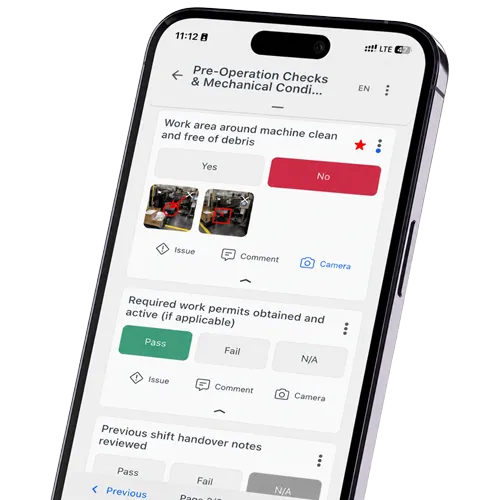
Digital checklists turn an instruction into structured production data by enforcing required steps, tolerances, response types and conditional follow-up actions. Each result can be associated with the operator, timestamp, asset, work order and supporting evidence such as measurements or images. An out-of-tolerance response should create or escalate an issue immediately instead of waiting until someone reviews a paper form.
How can digital communication systems improve shift handovers in manufacturing?
A useful digital handover records unresolved abnormalities, downtime, quality holds, maintenance work, safety issues and the next required action by line or asset. Entries should carry timestamps, responsible persons, status and supporting measurements or photos, while critical items require explicit acknowledgement by the incoming shift.
How can manufacturing communication systems automatically escalate quality or safety issues?
Define escalation rules based on severity, process limits, response time and responsibility: an out-of-tolerance inspection result can create a deviation, assign an owner and escalate it if it remains unacknowledged. Alarm priorities must reflect consequence and required operator response rather than generating more notifications; this follows the alarm-management principles of ISA-18.2. Safety-critical protective functions must remain in appropriately designed safety systems such as an SIS and must not depend on an app-based workflow or cloud notification
What role does ISA-95 play in manufacturing communication systems?
ISA-95, published internationally as IEC 62264, defines the levels between control systems and business systems and the vocabulary used to describe what moves between them. It is a reference model rather than a protocol, so it tells you which information belongs at which level, not how to transmit it. Teams use it mainly to agree on scope before they argue about tools.
Do communication records count as documented information under ISO 9001?
They do when they provide evidence that a required process ran, for example a corrective action being assigned and closed. The standard names no format. What matters is that the record can be retrieved, read and controlled.