Skip to content
 EN
EN  DE
DE  العربية



Audit: Definition, Types, and How It Differs from an Inspection
Audit determines whether a process, system, or organization meets a defined set of criteria, using evidence gathered through document review, interviews, and direct observation. Quality, EHS, and financial teams rely on audits to confirm conformity with standards such as ISO 9001 and ISO 19011, expose systemic risks, and create a documented trail auditors and regulators can trust.
What are the main types of audits?
Internal audits, external audits, and compliance audits answer three different questions, even though the word “audit” gets used interchangeably for all three. An internal audit is carried out by people inside the organization to check whether its own processes and controls actually work as designed. It exists to catch problems before a customer, regulator, or certification body finds them.
An external audit is conducted by an independent party with no stake in the outcome, which is exactly why its conclusions carry more weight with investors, regulators, or certification bodies. A quality control audit narrows the scope further, focusing specifically on whether products and services meet defined quality specifications rather than the whole management system.
Financial audits, safety audits, and supplier audits follow the same logic but apply it to a different domain: money, workplace risk, or a vendor’s own processes. The type of audit determines who performs it, what evidence counts, and how the findings get used afterward.
How is an audit different from an inspection or an assessment?
An audit examines whether a system or process conforms to defined criteria, while an inspection checks whether a specific item, product, or location meets a physical standard right now. A fire extinguisher inspection asks a yes-or-no question: is it there, is it charged, was it checked this month. An audit of the same facility asks a harder question: does the organization actually own and manage fire safety as a system, with training records, maintenance schedules, and accountability behind it.
An assessment sits between the two. It evaluates the overall effectiveness or maturity of a process, often relying more on the assessor’s professional judgment than on a fixed checklist of pass-fail criteria. Audits typically produce a formal conformity decision backed by documented evidence. Inspections produce an immediate pass, fail, or list of defects. Assessments produce a judgment call about how mature or capable something is.
Confusing the three has practical consequences. Scheduling a 20-minute inspection when a process actually needs a full systemic audit means root causes stay hidden, and the same defect resurfaces at the next visit.
What does an audit process actually involve, step by step?
An audit process typically runs through five stages, each producing a specific output the next stage depends on.
- Planning. The audit team defines scope, criteria, and objectives, usually based on risk: which processes, sites, or standards get prioritized this cycle, and why.
- Preparation. Auditors review prior findings, relevant documentation, and applicable standards before setting foot on site, so fieldwork time goes toward verification instead of orientation.
- Fieldwork. The team gathers evidence through document review, interviews, and direct observation of the process in action, cross-checking what people say against what actually happens.
- Reporting. Findings get classified, typically as conformities, minor nonconformities, or major nonconformities, and documented with enough detail that someone who wasn’t there can understand and act on them.
- Follow-up. Corrective actions get assigned an owner and a deadline, and their effectiveness gets verified at a later date, closing the loop instead of leaving the finding open indefinitely.
This structure follows the logic behind ISO 19011, the international guideline for auditing management systems, which frames auditing as a full lifecycle rather than a single site visit.
Who conducts an audit, and what makes an auditor independent?
Audit independence comes from having no personal or financial stake in the outcome being reviewed, not from job title alone. An internal auditor can be independent of the specific process they’re reviewing even while working for the same company, as long as they don’t report to the people responsible for that process. An external auditor achieves independence by working for a separate organization entirely, whether that’s a certification body, a regulator, or a client’s own audit function reviewing a supplier.
ISO 19011 sets out competence expectations for auditors, covering technical knowledge of the relevant standard, personal attributes such as impartiality, and hands-on auditing experience. Without that competence, an audit can still happen, but its conclusions carry less weight with certification bodies and stakeholders.
Auditor independence protects the value of the finding itself. A nonconformity identified by someone with no incentive to look the other way is far more credible to a board, a customer, or a regulator than the same finding raised by the process owner.
Why do the same audit findings keep coming back?
Audit findings repeat when the corrective action addresses the symptom instead of the underlying system. A missing torque log gets replaced once, the finding gets closed, and six months later the same field is blank again because nothing changed about how the checklist gets enforced day to day. Internal audit teams report this pattern getting worse, not better, as resources tighten. The IIA’s 2026 North American Pulse of Internal Audit, based on 373 responses from senior audit leaders, found that budget cuts to internal audit functions rose from 11 to 19 percent between 2024 and 2025, leaving fewer people to chase down whether prior fixes actually stuck.
Recurring findings usually trace back to weak follow-up rather than a one-time failure. If nobody owns the corrective action after the audit closes, verification never happens, and the next audit cycle rediscovers the same gap under a new finding number.
What are the most common audit mistakes that undermine results?
Audit quality breaks down in a handful of predictable ways, regardless of industry or standard.
- Scope creep during fieldwork. Auditors drift into areas outside the defined scope, which stretches the audit and dilutes focus on the criteria that actually matter for this cycle.
- Evidence based on interviews alone. A finding built only on what someone says, without a document, record, or direct observation to back it up, won’t hold up under challenge later.
- Findings without a clear owner. A nonconformity gets logged but never assigned to a specific person with a deadline, so it drifts in a spreadsheet until the next audit rediscovers it.
- No effectiveness check on corrective actions. A fix gets marked complete the moment it’s implemented, without confirming weeks later that it actually solved the problem.
- Treating the audit as the finish line. Once the report is filed, attention moves elsewhere, and the follow-up stage, which is where recurring findings actually get broken, never happens.
When does an audit make sense, and when is a lighter check enough?
An audit makes sense when the question is systemic: does this process, department, or management system reliably do what it’s supposed to do, across time and across people. A daily equipment check or a pre-shift safety walk doesn’t need that level of rigor. It needs a fast, repeatable inspection.
Reach for a full audit ahead of certification renewals, after a significant process change, following a serious incident, or when a customer contract requires documented proof of conformity. Reach for an inspection or a routine check when the goal is catching an immediate physical defect: a guard rail out of place, a fire extinguisher past its check date, a machine running outside spec.
Running a full audit program on top of routine inspections, rather than instead of them, is usually the right call. Inspections catch the day-to-day defect. Audits catch the reason the defect keeps happening.
How this plays out on a production line
A packaging line kept failing the same torque-check finding every audit cycle for over a year. The paper checklist had a blank field for torque values, and operators skipped it under time pressure. Auditors replaced the free-text field with a mandatory numeric entry tied to a defined tolerance range, so the checklist could not be submitted incomplete. Repeat findings on that specific check dropped to zero within two audit cycles.
Build audits that don’t repeat the same findings
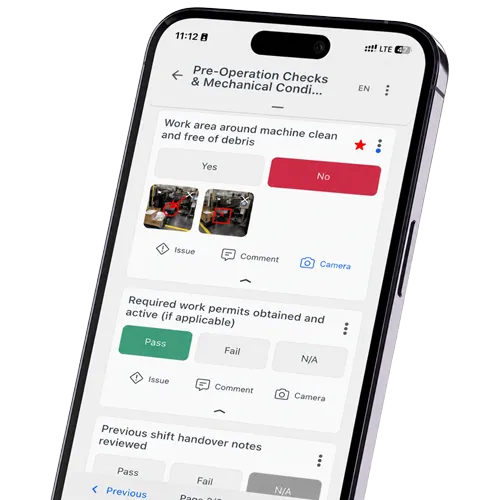
The mini-case above depends on one thing: a checklist structure that makes skipping a step or leaving a field blank technically impossible. flowdit turns audit checklists, findings, and corrective actions into one connected workflow, so evidence is captured on the spot, actions get an owner and a deadline automatically, and closed findings stay closed. That’s how audit programs stop producing the same nonconformity year after year.
Free Audit Checklist & Findings Log
Plan the audit, capture conformities and nonconformities on the spot, and track every finding to a verified close on one sheet. Download the checklist (PDF). You can also complete the checklist digitally in flowdit on your phone, tablet or PC.
Further Reading
- Audit-Management-Software – plan & run audits
- The Key Differences Between an Audit and an Inspection