
Field Safety Walk Checklist
Use this template with flowdit
- Customize this template or build your own
- Complete inspections using the mobile app
- Get reports and analyze your data
Start inspecting smarter — free for one user.


Follow the points below to conduct an effective field safety walk using this template:
- Review the task-specific safety plan (TSSP) and ensure it is signed and posted for each active task.
- Walk through each work zone systematically, observing housekeeping, guarding, and general conditions.
- Check required postings, emergency routes, and first aid supplies for accessibility and currency.
- Inspect personal protective equipment (PPE) usage, including hard hats, safety glasses, gloves, and fall protection gear.
- Evaluate high-risk areas such as excavations, confined spaces, ladders, and scaffolds for compliance with safety standards.
- Document all observations using the checklist, rating each item as Safe, At Risk, or N/A.
- Summarize findings, assign corrective actions, and review the results with the project team.
Start inspecting smarter — free for one user.
What is a Field Safety Walk?
Why Field Safety Walks Matter
What to Include in a Field Safety Walk Checklist
A comprehensive field safety walk checklist should cover all major hazard categories present on a construction site. Based on the checklist, key sections include:
- Task-Specific Safety Plans: Ensure TSSPs are reviewed, signed, and posted for each active task.
- Safety Behavior & Culture: Observe near miss reporting, hazard recognition, and behavioral safety.
- Work Areas & Housekeeping: Check for clear walking surfaces, guarded edges, and organized storage.
- Required Postings: Verify OSHA posters, emergency routes, and contact lists are displayed.
- Health & First Aid: Confirm first aid kits are stocked, eye wash stations accessible, and trained personnel available.
- Personal Protective Equipment: Inspect hard hats, safety glasses, gloves, hearing protection, and other PPE.
- Fall Protection: Check anchorage points, personal fall arrest systems, and rescue plans.
- Ladder, Tools, and Equipment: Ensure ladders are inspected, tools are in good condition, and whip-checks are installed.
- Excavation & Confined Space: Verify competent persons, protective systems, and emergency plans.
- Electrical, Fire, and Rigging: Check for safe practices and equipment.
- Scaffold, Crane, and Heavy Equipment: Ensure proper setup and operation.
- Hazard Communication: Verify labeling and safety data sheets.
- Additional Observations: Document any other hazards or recommendations.
Each item is rated Safe, At Risk, or N/A, and findings are summarized for action.
How to Conduct a Field Safety Walk
To conduct an effective field safety walk, follow these steps:
- Prepare by reviewing the task-specific safety plans and any previous inspection findings.
- Assemble the necessary PPE and the checklist.
- Start at the site entrance and walk through each work zone in a logical order, covering all areas.
- Observe conditions systematically: look for housekeeping, guarding, PPE usage, and equipment condition.
- Use the checklist to document each item, noting any at-risk conditions with specific details.
- Engage with workers and supervisors to discuss observations and gather input.
- After the walk, compile the findings, assign corrective actions with deadlines, and share the results with the project team.
- Follow up on corrective actions to ensure they are completed.
The checklist provides a consistent framework, but the walk should also include informal conversations and observations of safety culture.
Common Mistakes to Avoid During Field Safety Walks
Even with a good checklist, field safety walks can be ineffective if common mistakes are made. Avoid these pitfalls:
- Rushing through the walk without thoroughly observing each area. Take time to look at details.
- Focusing only on obvious hazards and missing less visible risks like confined spaces or electrical hazards.
- Not engaging with workers; their input is valuable for identifying hidden issues.
- Failing to document observations accurately; vague notes make it hard to track corrective actions.
- Ignoring positive observations; recognizing safe behaviors reinforces good practices.
- Not following up on corrective actions; without closure, hazards persist.
- Using the checklist as a one-time event; regular walks are needed to maintain safety.
By avoiding these mistakes, you can maximize the effectiveness of your field safety walks and create a safer work environment.
Frequently Asked Questions
A comprehensive field safety walk checklist should include sections for:
- Task-specific safety plans and documentation
- Safety behavior and culture observations
- Work area housekeeping and guarding
- Required postings and emergency information
- Health and first aid preparedness
- Personal protective equipment (PPE) compliance
- Fall protection systems and equipment
- Ladder, tool, and equipment safety
- Excavation and confined space safety
- Electrical, fire, and rigging safety
- Scaffold, crane, and heavy equipment operations
- Hazard communication and additional observations
Each section contains specific items to check, with ratings of Safe, At Risk, or N/A.

Still managing operations with paper and Excel?
Digitize inspections, audits, SOPs, and corrective actions.
Book A Personal Demo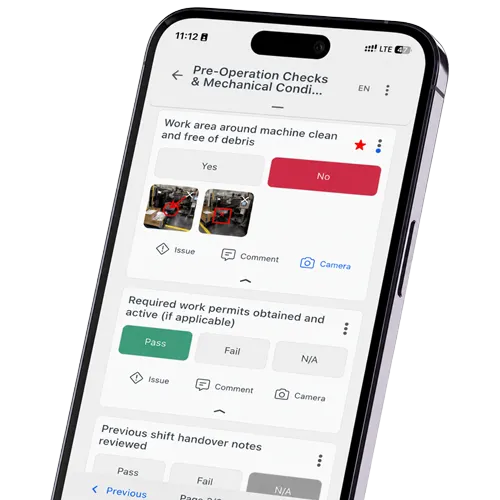
Resources Under The Same Category

Fall Prevention Program Checklist
Use this fall prevention program checklist to plan programs for older adults in ...
View template →
OSHA Hand and Power Tools Inspection Checklist
This hand and power tools checklist promotes workplace safety by thoroughly eval...
View template →
Civil Construction Safety Inspection Checklist
This civil construction safety inspection checklist helps improve safety perform...
View template →
Heavy Equipment Daily Inspection Checklist
Use this heavy equipment daily inspection checklist before each shift on excavat...
View template →
Vehicle Hop-Up Checklist
Use this vehicle hop-up checklist before any work at height. Confirm a hop-up or...
View template →
Abrasive Wheel Pre-Use Checklist for Grinders
Use this abrasive wheel pre-use checklist to inspect portable grinders and cut-o...
View template →Ready to simplify inspections and get your team moving faster?
Start free today and turn inspections into a clear, consistent digital workflow. Prefer a guided walkthrough? Book a demo and see how flowdit can fit your team.